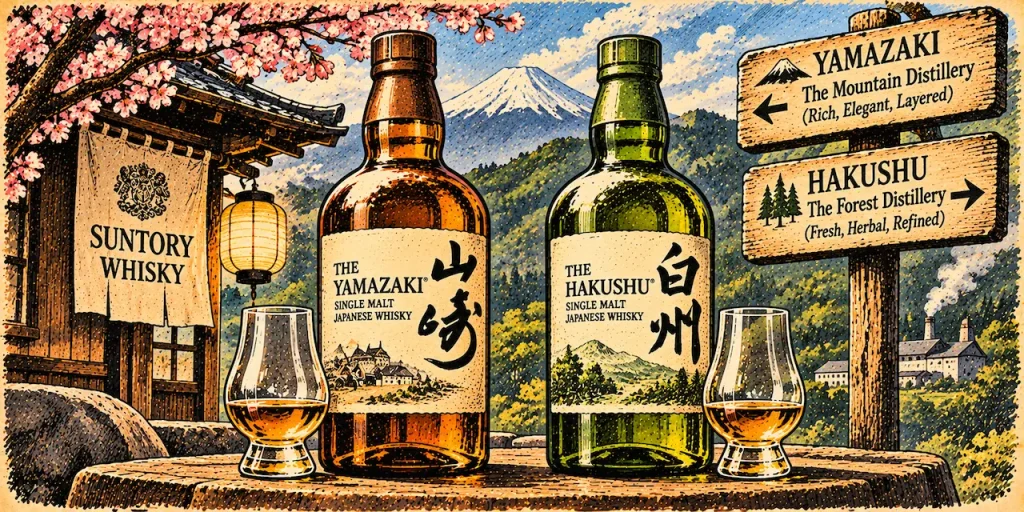
Suntory owns the two most important malt distilleries in Japan, and it built them to be different on purpose. Yamazaki, founded in 1923 on the outskirts of Kyoto, was the country’s first. Hakushu, opened fifty years later in the forests of the Southern Alps, was designed as its counterpart: a second house whose malt would give Suntory’s blenders a different set of flavours to work with. Half a century on, the two are sold as single malts in their own right, and tasting them side by side is the fastest education available in what Japanese whisky is actually trying to do.
Why Yamazaki is where it is
Shinjiro Torii, Suntory’s founder, chose the Yamazaki site for reasons that were partly practical and partly poetic. It sits at the confluence of three rivers — the Katsura, Uji and Kizu — in a valley where the mingling waters create a persistently humid, misty microclimate. The water is soft and was already famous: the sixteenth-century tea master Sen no Rikyū reputedly built a tea house nearby for its quality. The site was also conveniently between Osaka and Kyoto for distribution.
Torii hired Masataka Taketsuru, who had studied distilling in Scotland, to set it up. Taketsuru wanted a cold northern site like the Highlands; Torii overruled him, and the disagreement eventually led Taketsuru to leave and found Nikka in Hokkaido. The Japan region page covers that split and everything that followed.
Yamazaki’s climate is the opposite of Scotland’s: hot, humid summers and mild winters. Whisky matures fast here, the angel’s share is high, and the spirit interacts with the wood more aggressively than it would in Speyside. Our maturation guide explains why climate matters so much.
Why Hakushu is where it is
By the 1970s Suntory needed more malt whisky and more variety. Keizo Saji, Torii’s son, chose a site at about 700 metres’ altitude on the slopes of Mount Kaikomagatake, in Yamanashi Prefecture, surrounded by dense forest. The water is granite-filtered and very soft; the air is cool and clean; the altitude lowers the boiling point of the wash and slows the pace of maturation.
Hakushu opened in 1973 and was, for a time, the largest malt distillery in the world by number of stills. A second plant, Hakushu East, was added in 1981. The “forest distillery” branding is not just marketing — the site is in a nature reserve and runs a bird sanctuary — but the real point is that it produces lighter, fresher, greener spirit than Yamazaki.
Variety within one distillery
Both distilleries do something unusual by Scottish standards: they produce many different styles of spirit under one roof. A Scotch distillery typically makes one new-make and gets its variety from wood. Suntory’s distilleries make several.
Yamazaki runs stills of different shapes and sizes — some with straight heads, some with bulges, some heated by direct fire — and different condensers, and uses different fermentation regimes including wooden washbacks with ambient bacteria. The result is a range of new-makes from light and estery to heavy and sulphury, each destined for different casks. Hakushu does the same, and in addition makes lightly peated spirit, which Yamazaki largely does not.
This is the Japanese blending philosophy in miniature: rather than trading casks with rival companies, as Scottish blenders have always done, Suntory builds the variety in-house. The blending guide explains why that matters for single malts as much as for Hibiki.
Wood, and mizunara
Both use a mix of ex-bourbon American oak, ex-sherry Spanish oak and new oak. Yamazaki is particularly associated with mizunara, Japanese oak (Quercus crispula), which Suntory first used out of necessity during the Second World War when imports stopped. Mizunara is porous, leaky, hard to coop and slow to give up its flavour, but after a decade or more it produces an unmistakable sandalwood, incense and coconut character. Yamazaki 18 carries a mizunara component; the dedicated Mizunara releases are among the most expensive Japanese whiskies made. Hakushu uses mizunara more sparingly, which fits its lighter spirit. Our cask types guide covers how Japanese oak compares with American and European.
The role of Hibiki
Neither distillery can be fully understood without the blend they were both built to serve. Hibiki, launched in 1989 for Suntory’s ninetieth anniversary, is the company’s flagship blended whisky and the primary reason both Yamazaki and Hakushu exist at the scale they do. For most of their history the two distilleries sent the large majority of their output into Hibiki and into Suntory’s cheaper blends — Kakubin, the whisky in Japan’s ubiquitous highball — and single-malt bottlings were a small, almost promotional sideline.
The blend draws Yamazaki’s fruit and sherry-cask depth, Hakushu’s freshness and gentle smoke, and grain whisky from Suntory’s Chita distillery on the coast near Nagoya, which itself produces several styles of grain spirit from different column configurations. The 24-faceted bottle, representing the twenty-four seasons of the old Japanese calendar, is one of the most recognisable in spirits.
This matters for the single malts because it explains their scarcity. When Japanese whisky demand surged, Suntory had to choose between protecting Hibiki — the brand with the broadest global distribution — and protecting the single malts. It chose, broadly, to protect the blend, which is why the Yamazaki and Hakushu 12s became so hard to find while Hibiki Japanese Harmony, a no-age-statement blend introduced in 2015, remained on shelves. The malts have been the junior partners from the beginning, however the collectors’ market now treats them.
How they taste
- Yamazaki 12: ripe peach, honey, a floral note, dried fruit from the sherry wood, a hint of mizunara spice, a smooth, rounded texture and a medium finish. Warm and fruit-led; the whisky equivalent of its humid valley.
- Hakushu 12: green apple, fresh mint, cucumber, pine, a whisper of smoke, a crisp texture and a clean, bright finish. Cool and fresh; the whisky equivalent of its forest.
The contrast is clear enough that Suntory uses it in its own marketing — Yamazaki is “the Pioneer”, Hakushu “the Forest” — but the point stands without the slogans. These are two different whiskies made with the same corporate philosophy in two different climates.
Both ranges run 12, 18 and 25 Year Old, plus the no-age-statement Distiller’s Reserve that was introduced in 2014 to protect aged stocks. Hakushu’s 18 is one of the most elegant peated whiskies made anywhere; Yamazaki’s 18 is a sherried, mizunara-touched classic that now sells for several times its price of a decade ago.
The availability problem
Any honest comparison has to address price. The global boom in Japanese whisky from around 2014 onward exhausted Suntory’s aged stocks. The 12 Year Olds disappeared from many markets, returned in limited quantities, and now sell for two to three times what they cost in 2013. The 18s have become collector pieces. This is not a quality statement; it is supply and demand, and the gap is closing slowly as whisky laid down in the 2010s comes of age.
The practical advice is that Distiller’s Reserve in both cases is a fair representation of the house style at a price still connected to reality, and that the 12s, where available at retail, remain worth it.
Which one
Yamazaki for fruit, warmth and depth; Hakushu for freshness, green notes and a trace of smoke. They are not rivals in the usual sense — they belong to the same company and were built to complement each other — so the right answer is often both, side by side. The Yamazaki and Hakushu distillery pages have the full histories, and our tasting notes are collected in the reviews as we publish them.