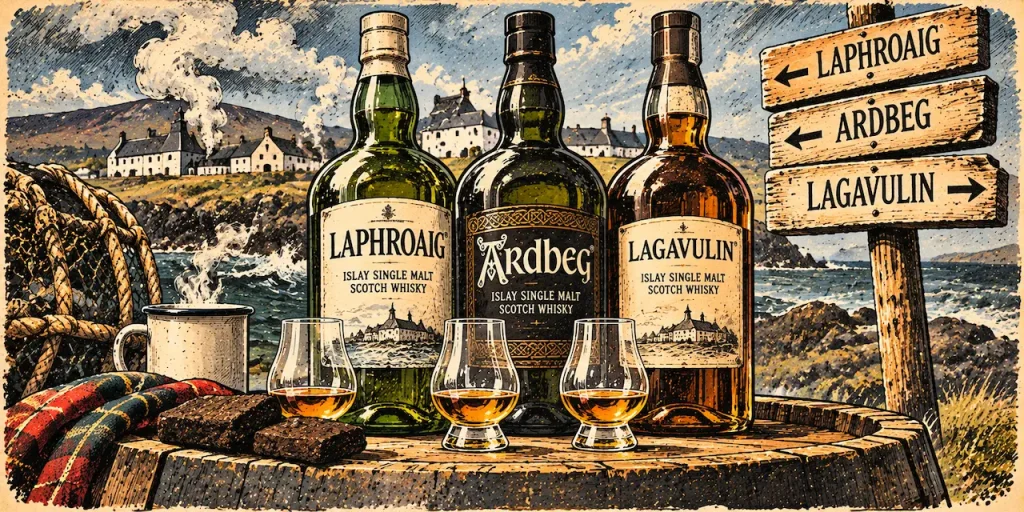
Drive the single-track road east out of Port Ellen on Islay and in the space of three miles you pass three of the most famous distilleries in the world: Laphroaig, then Lagavulin, then Ardbeg. They draw water from the same hills, buy most of their malt from the same maltings in Port Ellen, mature in sea-facing warehouses within sight of each other and have shared staff, casks and gossip for two centuries. They also make whiskies that any regular drinker can tell apart blind.
How three neighbours ended up with three signatures is the best illustration in Scotch of how much the details matter.
The shared foundation
All three use heavily peated malt. Peat is cut from Islay bogs, burned under germinating barley in the kiln, and the smoke deposits phenolic compounds on the grain. The level is measured in parts per million of phenols in the malt; Lagavulin runs around 35 ppm, Laphroaig around 40–45, Ardbeg around 50–55. Those numbers are useful but overrated — a great deal of the phenol content is lost in mashing, fermentation and distillation, and what survives depends on how each distillery runs its process. Our peat guide covers why ppm is only the beginning of the story.
All three are on the south coast, which gives them the maritime, medicinal, seaweed character people associate with “Islay” as a flavour. And all three are old: Lagavulin licensed in 1816, Laphroaig in 1815, Ardbeg in 1815. The Islay region page has the wider picture.
Laphroaig: the medicine cabinet
Laphroaig is the most divisive of the three. The signature is a sharp, iodine, TCP-and-bandages note that people either love instantly or never come round to. It comes from several sources.
First, Laphroaig still malts a portion of its own barley on traditional floor maltings — roughly a fifth of what it uses — and kilns it with peat cut from its own bog on the Glenmachrie moss. That peat is different from the Port Ellen maltings’ peat: wetter, more rooty, lower in the lignin that gives sweeter smoke. The distillery also kilns the malt with peat smoke early in the drying, when the grain is damp and absorbs more phenol.
Second, the stills. Laphroaig has seven: three wash stills and four spirit stills, one of which is much larger than the others, which the distillery deliberately runs to produce a different cut. The spirit cut is taken relatively late, keeping some of the heavier, more phenolic fractions.
Third, Laphroaig uses almost exclusively ex-bourbon casks, many of them first-fill Maker’s Mark barrels (both brands belong to Suntory). American oak gives vanilla and sweetness that pulls against the medicinal edge rather than smothering it.
Taste: Laphroaig 10 is iodine, smoke, seaweed, a surprising sweetness underneath, and a long, drying, ashy finish. Quarter Cask, finished in small casks, is richer and sweeter. The 10 Cask Strength is the purest statement of the style.
Lagavulin: the slow one
Lagavulin is the most measured of the three. It uses malt from Port Ellen, peated to a slightly lower level than its neighbours, and runs the slowest distillation on the island — a spirit run of around ten hours, compared with about five at many distilleries. Slow distillation means more copper contact and a more refined spirit, with the smoke integrated rather than sitting on top.
The stills are pear-shaped with a pronounced bulge, and the spirit cut is taken relatively high, which is why the new-make is less sharply phenolic than Laphroaig’s despite similar malt.
Lagavulin’s classic expression is sixteen years old, which is unusual for a flagship, and it is matured mostly in refill casks with a modest sherry component. The combination of long slow distillation, long maturation and refill wood gives a whisky that is deep rather than loud. Our guide to fermentation and distillation explains how distillation speed affects the result.
Taste: Lagavulin 16 is rich peat smoke like a bonfire rather than a hospital, dried fruit, a Lapsang Souchong tea note, dark chocolate, and a finish that goes on for minutes. The 8 Year Old is brighter and more aggressively smoky. The annual Distillers Edition, finished in Pedro Ximénez casks, is sweeter and heavier.
Ardbeg: the peaty one that’s also fruity
Ardbeg uses the most heavily peated malt of the three and yet frequently tastes the sweetest. The explanation is in the still house. Ardbeg’s spirit still has a purifier — a small copper pipe near the lyne arm that catches heavier vapours and returns them to the still for redistillation. It acts like a tiny extra distillation, stripping some of the heaviest, oiliest compounds and producing a spirit that is both intensely smoky and surprisingly delicate: citrus, pear and vanilla sit right alongside the tar and soot.
Ardbeg’s history is also relevant. It closed in 1981 and stood silent for most of a decade before Glenmorangie bought it in 1997 and rebuilt its reputation almost from nothing. Its modern range was designed by Bill Lumsden, Glenmorangie’s whisky-maker, with a willingness to experiment — the Committee releases, the wood finishes, the annual Ardbeg Day bottling — that the other two have been slower to match.
Wood is mainly ex-bourbon, with sherry components in Uigeadail and others.
Taste: Ardbeg 10 is tar, lemon, vanilla, bacon fat, a peppery kick and a long, sweet-smoky finish. Uigeadail adds sherry-cask raisin and treacle. Corryvreckan is the biggest and most peppery.
Three owners, three strategies
It is no accident that the three have diverged as they have; they belong to three different multinationals with three different ideas about what an Islay malt is for.
Lagavulin is Diageo’s, and Diageo has treated it as a jewel to be kept fairly still. The range is small, the 16 Year Old has barely changed in decades, and the annual releases — the Distillers Edition, the Special Releases, the Feis Ile and Jazz Festival bottlings — are additions to a stable core rather than replacements for it. Lagavulin also supplies smoke to White Horse and other Diageo blends, which has always limited how much is available as single malt.
Laphroaig belongs to Suntory, via Beam, and has been pushed harder on volume. The core range expanded through the 2010s with Select, Quarter Cask, Triple Wood, Lore and the PX Cask, several of them no-age-statement, which drew criticism from drinkers who felt the 10 was being crowded out. The Friends of Laphroaig scheme, with its square foot of Islay land for every member, remains one of the most effective loyalty programmes in spirits.
Ardbeg is LVMH’s, through Glenmorangie, and is run like a fashion house: a committee of devotees, an annual Ardbeg Day release with a theme and a story, a steady flow of limited editions with names like Supernova and Blaaack. That approach has made Ardbeg the most talked-about of the three among younger enthusiasts, and it has driven a new distillery expansion that doubled capacity in 2019.
None of this changes what the stills do, but it shapes what reaches the shelf and at what price.
The same island, three answers
Line them up by a single variable each:
- Peat character: Laphroaig medicinal, Lagavulin bonfire, Ardbeg tar and soot.
- Spirit weight: Laphroaig oily and heavy, Lagavulin rich and rounded, Ardbeg surprisingly light.
- Sweetness: Ardbeg most, Lagavulin middle, Laphroaig least at entry level.
- Wood: Laphroaig bourbon-led, Lagavulin refill and sherry, Ardbeg bourbon with sherry accents.
- Signature age: Laphroaig 10, Lagavulin 16, Ardbeg 10.
The lesson is that peat is not a single flavour. It is a raw material that each distillery processes differently through malting (see our malting and mashing guide), fermentation, still shape, cut points and wood, and the output can be as varied as any unpeated region’s.
Where to start
If you have never had a peated whisky, Lagavulin 16 is the friendliest first step, because its smoke is woven into fruit and sweetness. If you want to find out whether you are a “Laphroaig person”, the 10 will tell you in one sip. Ardbeg 10 is the one most likely to convert a sceptic, because the citrus and vanilla give the palate something to hold onto. The full ranges are covered on the Laphroaig, Lagavulin and Ardbeg distillery pages, our tasting notes are collected in the reviews as we publish them, and the three-way comparison repays doing at home with three glasses on one evening.