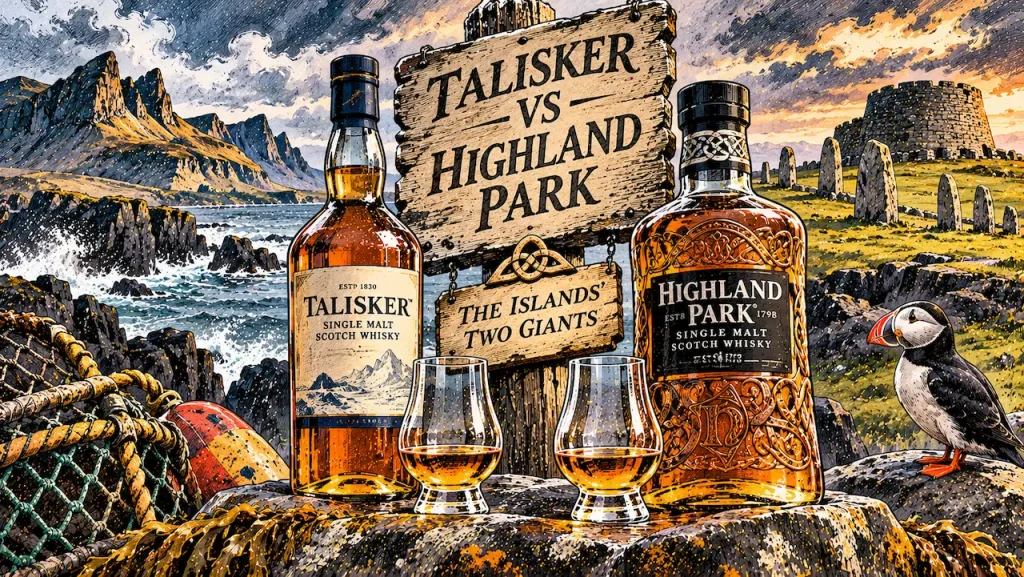
Scotland’s islands are not a legal whisky region — they are, on paper, part of the Highlands — but the trade has always treated them as one, and two distilleries dominate the category. Talisker, from Skye, has been the island malt for most of the twentieth century, a staple of blends and the Classic Malts range. Highland Park, from Orkney, is the northernmost distillery in Scotland and has been marketed as the best all-rounder in Scotch. Both are peated, both are coastal, both are owned by large companies, and both have a Viking in the marketing somewhere. The whiskies, however, have little in common, and the comparison explains why “island” is a geography rather than a style.
The Islands region page covers the whole group; the Highland region page notes where they sit legally.
Two very different islands
Skye is big, mountainous and wet, with the Cuillin ridge rising behind the distillery at Carbost on the shore of Loch Harport. The weather is dramatic and the warehouses face a sea loch. Orkney is low, treeless and windswept, a cluster of green islands north of the mainland where the peat is heather rather than forest and the climate is cool and steady. The two islands have different peat, different water and different exposures, and the whiskies reflect it.
Talisker
Talisker was founded in 1830 by the MacAskill brothers, two Skye landowners who had cleared tenants from their land for sheep and wanted a distillery to make the estate pay. It had a difficult century — bankruptcies, a change of owners, a period of triple distillation that ended in 1928, and a fire in 1960 that destroyed the still house, which was rebuilt with exact replicas of the old stills. Since the 1920s it has belonged to the Distillers Company and its successors, and today to Diageo. The Talisker page has the full story.
The spirit is shaped by two unusual features. The lyne arms — the pipes from the still heads to the condensers — have a sharp U-bend with a purifier pipe that returns some of the heavier vapours to the still, producing a lighter spirit than the wash would otherwise give. And the condensers are worm tubs: coiled copper pipes submerged in cold water outdoors, which cool the vapour quickly and give the spirit less copper contact, leaving more of the sulphury, meaty character that gives Talisker its weight. Our guide to fermentation and distillation covers both.
The malt is peated to around 18–22 ppm, moderate by Islay standards, and the smoke that results is woven through with pepper — black pepper, chilli heat, a catch at the back of the throat that is the distillery’s signature. Maturation is mostly in refill American oak, which keeps the spirit visible. Talisker is bottled at 45.8 per cent across its core range, an oddity dating from an old proof measure that the company has kept as a trademark.
Taste: Talisker 10 is sea spray, smoke, black pepper, a sweet malty core, and a long, warming, peppery finish. The 18 is rounder and more honeyed; Storm and Skye are no-age-statement variations; the Distillers Edition is finished in amoroso sherry casks. Talisker 57° North is the cask-strength statement.
Highland Park
Highland Park dates its founding to 1798 and a smuggler and church officer named Magnus Eunson, who allegedly hid his illicit whisky under the pulpit. The distillery stands above Kirkwall, Orkney’s main town, and has been owned by Highland Distillers and its successor Edrington — the owner of Macallan — since the 1930s. The Highland Park page tells it in full.
Three things define the whisky. The first is the floor maltings, where about a fifth of the distillery’s barley is still malted by hand and kilned over peat cut from Hobbister Moor. Orkney peat is heather, not tree, because the islands have been treeless for thousands of years; it burns to a fragrant, floral smoke quite unlike Islay’s. The remaining malt is unpeated, bought from the mainland, and the two are mixed, which gives a whisky that is lightly smoky overall — around 20 ppm in the house-malted portion, much less in the blend — with the smoke carrying a distinct heathery sweetness. The peat guide explains why peat from different places smells so different.
The second is sherry wood. Highland Park matures predominantly in sherry-seasoned casks, both European and American oak, commissioned by Edrington and seasoned in Jerez, which gives the whisky dried-fruit depth and a rich colour the distillery is proud to say is natural. The cask types guide covers the distinction.
The third is harmonisation: casks are married for several months before bottling, which the distillery credits with the whisky’s balance.
Taste: Highland Park 12 is honey, heather, orange peel, a gentle floral smoke, a little sherry fruit and a medium, smooth finish. The 18 is deeper, with more dried fruit and a rounder smoke, and has long been one of the most consistently praised whiskies in Scotland. The range has been through a Viking-themed rebrand — Viking Honour, Viking Pride, Valkyrie, Valknut — that enthusiasts generally regard as regrettable, though the liquid underneath has stayed the course.
Side by side
- Peat: Talisker moderate and peppery; Highland Park light and heathery.
- Spirit: Talisker heavy, sulphury, worm-tub weight; Highland Park cleaner, fruitier.
- Wood: Talisker refill bourbon; Highland Park sherry-led.
- Signature: Talisker pepper and sea; Highland Park honey and heather.
- Strength: Talisker 45.8 per cent; Highland Park 40 at entry, 43 above.
- Owner: Diageo; Edrington.
They are, in effect, the island equivalents of a coastal Highland malt and a sherried Speysider, which is why they appeal to different drinkers. Talisker is the choice for someone who likes Lagavulin but wants less smoke and more pepper; Highland Park for someone who likes Macallan but wants a whisper of smoke.
The rest of the islands
The two giants cast a long shadow over the others, which is a reason to mention them. Jura, across the sound from Islay, makes a soft, slightly oily malt that has recently added peated expressions. Tobermory on Mull makes an unpeated whisky under its own name and a heavily peated one as Ledaig, which is among the most distinctive smoky malts in Scotland. Arran, founded in 1995, has become the model for a modern island distillery with a loyal following and a second site, Lagg, for peated whisky. Scapa, Highland Park’s near neighbour on Orkney, makes a honeyed, unpeated malt in a Lomond still. Raasay, Torabhaig on Skye, the Isle of Harris and others have opened since 2015. None has the scale or the history of Talisker or Highland Park, but together they make the case that “island whisky” covers more ground than the two names most people know.
The Viking question
Both distilleries have leaned on Norse heritage in their marketing, Highland Park far more heavily. Orkney was Norwegian until 1472, and the Viking framing is at least historically grounded; Skye’s Norse past is real too, though Talisker has made less of it. The branding is a reminder that the islands’ identity is a selling point in its own right, independent of what is in the glass.
Which to buy
For pepper and sea: Talisker 10, one of the best-value malts in Scotland. For balance: Highland Park 12. For a serious bottle: Highland Park 18, which deserves its reputation. For strength: Talisker 57° North.
Our tasting notes on both ranges are collected in the reviews as we publish them, and the comparison comes down to this: these are two excellent distilleries that share an island category and a marketing department’s fondness for longships, and almost nothing else.