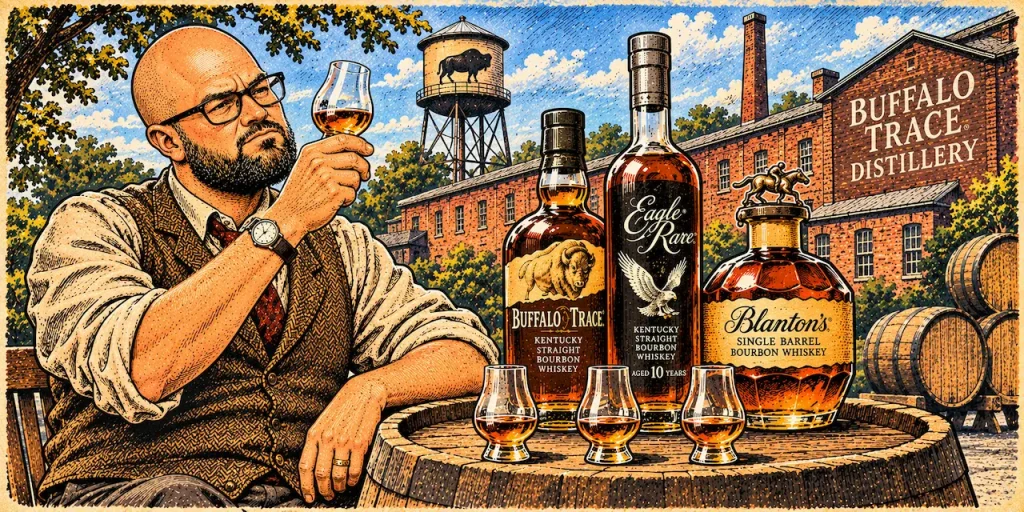
Few places in whisky generate as much obsession per square metre as the Buffalo Trace distillery in Frankfort, Kentucky. It makes Pappy Van Winkle. It makes George T. Stagg, W.L. Weller, E.H. Taylor and Elmer T. Lee. And it makes three bourbons that have become everyday grails for drinkers who cannot find the rarer stuff: Buffalo Trace itself, Eagle Rare 10 Year Old and Blanton’s Single Barrel. All three come from the same stills on the same site. People queue for all three. Yet they are quite different whiskies, and the differences are instructive.
One site, two recipes
Buffalo Trace runs two bourbon mash bills, neither of which it publishes exactly.
- Mash Bill #1 is a low-rye recipe — under 10 per cent rye, by common estimate, with the balance in corn and malted barley. It produces a soft, sweet, corn-forward spirit. Buffalo Trace, Eagle Rare, George T. Stagg, Stagg Jr., E.H. Taylor and Benchmark are all made from it.
- Mash Bill #2 is a higher-rye recipe, in the region of 12–15 per cent rye. It gives a spicier, more aromatic spirit. Blanton’s, Elmer T. Lee, Rock Hill Farms, Hancock’s President’s Reserve and Ancient Age all come from it.
So the first distinction is simple: Buffalo Trace and Eagle Rare are siblings from the same mash; Blanton’s is a cousin from a different one. Our bourbon style page explains how far a few percentage points of rye can move the flavour.
Buffalo Trace: the flagship
The distillery traded as George T. Stagg for most of the twentieth century and was renamed Buffalo Trace in 1999, with the flagship bourbon launched the same year. It is a no-age-statement bourbon, roughly eight to ten years old by most accounts, drawn from barrels across many warehouses and blended for consistency. It is bottled at 45 per cent.
Buffalo Trace was conceived as the distillery’s “everyday” bourbon — well-made, affordable, widely distributed. For a decade it was exactly that. The bourbon boom of the 2010s changed its fate: as Pappy, Stagg and Weller became unobtainable, drinkers moved down the ladder, and Buffalo Trace became the scarce one. In the United States it is allocated; in some states it is as hard to find as the limited editions it was meant to sit beneath.
Taste: brown sugar, vanilla, light oak, a touch of mint, a soft, rounded texture and a medium finish. It is a textbook low-rye bourbon.
Eagle Rare: the same spirit, older
Eagle Rare was originally a Seagram brand, created in 1975, and came to the distillery when Sazerac bought it in 1989. It uses the same Mash Bill #1 as Buffalo Trace and is aged at least ten years, which places it at the older end of the mainstream bourbon shelf.
For many years Eagle Rare 10 was labelled “single barrel”. Around 2014 the wording changed to reflect a small-batch bottling process — barrels are selected individually but the bottling line can mix a few — though the distillery insists the character is unchanged. The bottling terms guide covers what “single barrel” and “small batch” actually promise.
Bottled at 45 per cent, Eagle Rare is effectively Buffalo Trace with two or three more years in oak, drawn from warehouses the distillery judges to give a more refined, less aggressive profile.
Taste: toffee, dried orange, leather, oak, a hint of cocoa, a drier and more structured palate than Buffalo Trace, and a longer finish. The extra age shows as polish rather than power.
There is also a 17 Year Old Eagle Rare in the annual Antique Collection, which is a different proposition entirely.
Blanton’s: the original single barrel
Blanton’s is the historically important one. In 1984, master distiller Elmer T. Lee created what is generally recognised as the first commercially marketed single barrel bourbon, naming it after Colonel Albert Blanton, who had run the distillery for decades and had the habit of bottling selected barrels from the metal-clad Warehouse H for his own guests.
Blanton’s is still drawn from Warehouse H, which is unusual in being clad in metal rather than brick. Metal warms up faster in summer and cools faster in winter, giving more extreme temperature cycles, which pushes the whisky in and out of the wood more aggressively. Our maturation guide explains the effect. Each bottle comes from a single barrel, at a declared barrel number and dumping date, bottled at 46.5 per cent (Blanton’s Original). Higher-strength versions — Gold at 51.5 per cent, Straight from the Barrel uncut — exist mainly for export markets.
The high-rye mash bill, the single warehouse and the single barrel combine to make Blanton’s the most variable of the three. Two bottles can taste noticeably different. The stopper — a racehorse and jockey, in eight different poses that spell B-L-A-N-T-O-N-S — did not hurt its collectability.
Taste: caramel, honey, citrus, a pronounced rye spice and pepper, dried fruit, a silky texture and a long, warm finish. Spicier and more aromatic than its stablemates, with more barrel-to-barrel character.
Why one distillery has so many brands
Visitors often ask why Buffalo Trace does not simply sell its whiskey under one name. The answer is that the brands are mostly older than the current ownership, and each came with a history worth keeping.
Sazerac, the New Orleans company that bought the distillery in 1992, inherited Ancient Age and Blanton’s with the site. It then spent two decades acquiring heritage labels as other companies shed them: Eagle Rare and Benchmark from Seagram, the Weller and Old Rip Van Winkle brands in a 2002 agreement with the Van Winkle family, E.H. Taylor as a tribute to the man who built the distillery’s early fame, and others. Each brand was assigned a recipe and a warehouse profile, so that the distillery could offer a range of distinct bourbons without building a second plant.
The strategy also spreads risk. In a downturn, a cheaper brand like Benchmark carries the volume; in a boom, allocated labels carry the prestige. And because all are made on one site from two mash bills, the distillery can shift barrels between brands as demand requires — which is one reason the age and profile of Buffalo Trace itself have reportedly drifted over the years as more barrels were needed higher up the range.
For the drinker, the lesson is that brand names on the Buffalo Trace shelf describe a combination of mash bill, warehouse and selection rather than a separate spirit. Knowing which is which turns a confusing wall of labels into a readable map.
Side by side
- Mash: Buffalo Trace and Eagle Rare low-rye; Blanton’s high-rye.
- Age: Buffalo Trace ~8–10 (unstated); Eagle Rare 10+; Blanton’s unstated, generally 6–9.
- Bottling: Buffalo Trace batched; Eagle Rare small batch; Blanton’s single barrel.
- Strength: 45 / 45 / 46.5 per cent.
- Character: Buffalo Trace sweet and soft; Eagle Rare dry and polished; Blanton’s spicy and expressive.
The allocation problem
All three are allocated in the US and, by extension, expensive or scarce elsewhere. Retail prices have held reasonably steady; secondary prices have not. Eagle Rare and Blanton’s regularly sell for two to three times retail on the grey market, and Buffalo Trace not far behind in some states.
The sober view is that none of the three is worth a secondary-market premium. Each is a very good bourbon at its retail price and an ordinary one at double it. Our how to build a collection guide has more on why chasing allocated bottles is usually a poor use of money.
Which to buy
If you find Buffalo Trace at retail, buy it; it is the best-value bourbon in its class. Eagle Rare is the one to choose if you prefer oak and dryness to sweetness. Blanton’s is the most distinctive and the most fun, with the single-barrel lottery as part of the appeal. The full stable, including the rarer siblings, is mapped on the Buffalo Trace distillery page, the wider context is on the Kentucky region page, and our tasting notes are collected in the reviews as we publish them.