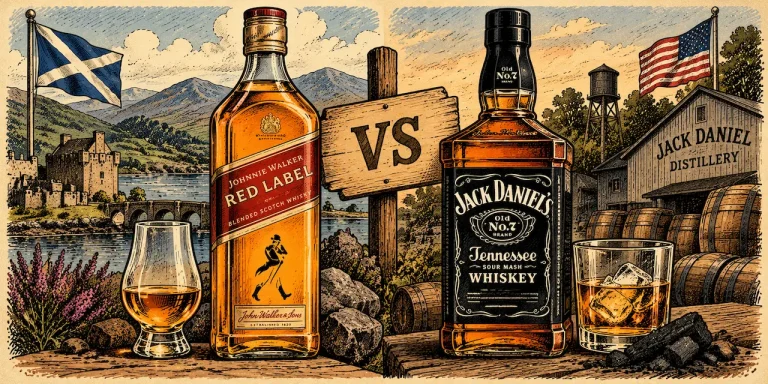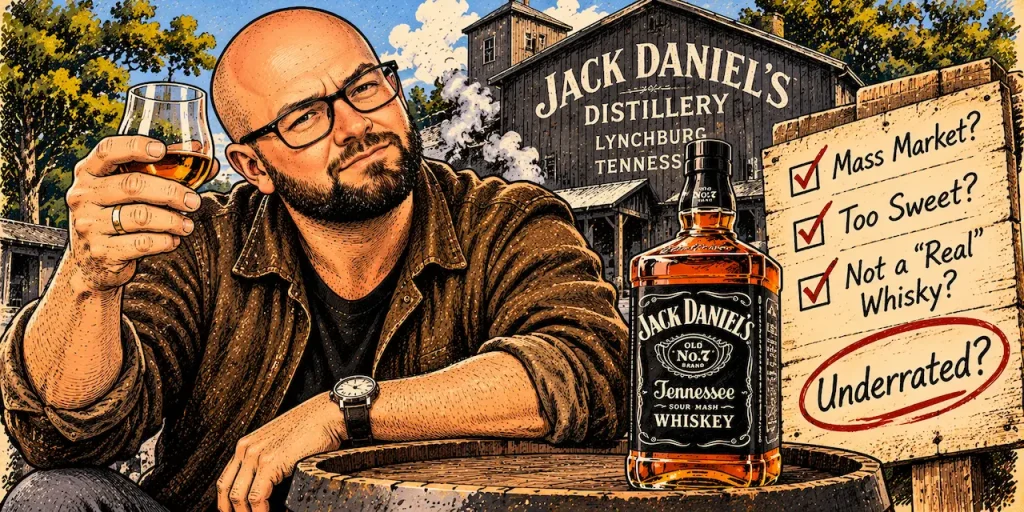
Jack Daniel’s has achieved something rather extraordinary. It has become one of the most recognisable whiskey brands on the planet, built an international business around a small town in Tennessee and persuaded millions of people to drink its whiskey. Yet mention Old No. 7 in the company of serious whisky enthusiasts and you’ll often be met with the sort of expression normally reserved for somebody who has just ordered a well-done steak in a French restaurant.
It’s too sweet, they’ll tell you. Too commercial. Too ordinary. Somebody will inevitably mention Coca-Cola, usually before recommending a bottle that costs three times as much and comes with a story about a warehouse nobody has ever visited.
I’ve never been particularly interested in defending billion-dollar drinks companies. Brown-Forman can afford its own public relations department, and I suspect it’s considerably better funded than mine. But the contempt directed at Jack Daniel’s has always struck me as rather excessive, particularly when so much of it seems to have little to do with the whiskey itself.
Old No. 7 isn’t a masterpiece. It has obvious limitations, and there are plenty of bottles I’d choose ahead of it for an evening of serious drinking. But there’s a difference between recognising those limitations and dismissing an entire distillery because its most famous product happens to be popular.
The trouble with being everywhere
Success can be a terrible thing for a brand’s reputation. Once something becomes sufficiently popular, a certain type of enthusiast decides it must be rubbish. You see it in coffee, beer, restaurants and practically any other subject where people have discovered that possessing obscure knowledge can be mistaken for having a personality.
Jack Daniel’s is an obvious target. The square bottle and black label are familiar in bars across the world, and Old No. 7 has become almost inseparable from the whiskey and Coke. It’s the sort of bottle people order without consulting a drinks menu or asking the bartender about the finer points of barrel maturation.
For some enthusiasts, that familiarity is enough to condemn it. They associate the brand with nightclubs, student parties and people who aren’t especially interested in whiskey. None of which tells us much about the liquid in the bottle, although it reveals a fair amount about the people making the complaint.
Popularity is hardly proof of quality. Plenty of dreadful products sell extremely well. But the reverse is equally true: a whiskey doesn’t become inferior simply because millions of people enjoy it. Jack Daniel’s has spent generations producing a recognisable, consistent spirit at a price ordinary customers are prepared to pay. That’s not the same as producing the world’s finest whiskey, but neither is it something to sneer at.
Tennessee whiskey is not a marketing invention
One of the stranger criticisms of Jack Daniel’s concerns its identity. Old No. 7 is labelled Tennessee whiskey rather than bourbon, which occasionally provokes an argument among people who really ought to have better things to do.
The distinction is worth understanding. Jack Daniel’s uses a mash bill of 80% corn, 12% rye and 8% malted barley, and its production meets the principal federal requirements associated with bourbon. The whiskey is matured in new charred oak barrels, just as bourbon must be. The company nevertheless identifies it as Tennessee whiskey, emphasising a regional production tradition known as the Lincoln County Process.
Before entering the barrel, the freshly distilled spirit passes through roughly ten feet of sugar maple charcoal. This process, commonly called charcoal mellowing, removes certain compounds and influences the character of the resulting whiskey. It’s a genuine production method with a long history in Tennessee, not an elaborate advertising invention designed to disguise inferior spirit.
Whether charcoal mellowing makes Jack Daniel’s better than a conventional bourbon is another question entirely. I wouldn’t argue that it does. The process creates a different result, and whether that result appeals to you is a matter of preference.
What I find peculiar is the insistence that Jack Daniel’s somehow isn’t legitimate American whiskey because it chooses a different classification. There are sensible reasons to criticise Old No. 7, but its production heritage isn’t one of them.
What you’re actually getting in the glass
Strip away the black label, the rock-and-roll associations and several decades of advertising, and Old No. 7 is a fairly straightforward American whiskey. Its familiar flavour profile combines caramel, vanilla, banana and toasted oak, with a little spice and woody bitterness beneath the sweetness.
The banana character is particularly distinctive. It comes partly from fruity compounds produced during fermentation, including an ester called isoamyl acetate. The corn-heavy mash and new charred oak barrels contribute to the broader sweet, vanilla-led profile.
There’s nothing especially mysterious about the result. Old No. 7 is approachable, relatively soft and easy to recognise, but it isn’t enormously complex. The finish is short, the flavours don’t develop through endless layers, and I wouldn’t choose it over a more interesting bourbon if I intended to spend an evening examining what’s in my glass.
Those are perfectly reasonable criticisms. What isn’t reasonable is judging a mainstream Tennessee whiskey as though it were supposed to compete with a rare single-cask Scotch costing several hundred pounds. It’s rather like complaining that a Volkswagen Golf doesn’t drive like a Porsche 911. Nobody sensible expected it to.
The standard Jack Daniel’s bottling is commonly sold at 40% ABV, which can leave it feeling a little thin beside stronger American whiskeys. Depending on local prices, bottles such as Wild Turkey 101 or Buffalo Trace may offer a more interesting alternative for somebody who prefers drinking whiskey neat. I’d certainly consider them before paying a premium for the familiar black label.
But that doesn’t make Old No. 7 a bad product. It makes it a whiskey designed with a different customer in mind.
The Jack and Coke problem
Jack Daniel’s association with Coca-Cola is probably responsible for more of its reputation among enthusiasts than anything happening at the distillery. For millions of people, Jack Daniel’s isn’t a whiskey to analyse. It’s something to pour over ice, top up with Coke and enjoy while doing something considerably more interesting than discussing fermentation temperatures.
And frankly, I struggle to see the problem.
A Jack and Coke works because the whiskey’s caramel, vanilla and sweet oak characteristics complement the mixer. The combination has a recognisable flavour, and Old No. 7 retains enough identity to avoid disappearing entirely beneath the cola. It isn’t an accident that the drink has become so popular.
I enjoy learning about whisky production, and there’s plenty of pleasure in taking time over a good single malt or bourbon. But I don’t believe every glass needs to become an educational exercise. Sometimes I want to pay attention to what I’m drinking; sometimes I’d rather concentrate on the conversation.
The idea that whiskey becomes less respectable when somebody adds a mixer is particularly tiresome. We don’t generally accuse espresso of being inferior because it works well with milk, yet whisky enthusiasts can become strangely offended by the sight of a perfectly ordinary drink being enjoyed in a perfectly ordinary way.
If you’re paying £200 for a rare single malt, I’d suggest trying it neat before drowning it in cola. If you’re drinking Jack Daniel’s at a barbecue, however, I doubt civilisation will collapse because you’ve added a few ice cubes and some Coke.
Mass production isn’t the same as poor production
Another familiar complaint is that Jack Daniel’s is industrial whiskey, as though the distillery were supposed to be operated by three elderly gentlemen filling barrels by candlelight.
Of course it’s industrial. The brand sells whiskey on a global scale, and producing that volume requires enormous infrastructure, sophisticated quality control and substantial inventories of maturing spirit. The romantic image of a lone craftsman tending a handful of barrels has very little to do with how most successful spirits businesses operate.
What tends to be overlooked is the difficulty of making a consistent product at that scale. Grain varies, fermentation conditions require careful management, and barrels develop differently depending on their position in the warehouse. Even oak from the same species of tree can produce noticeably different results.
Yet customers expect Old No. 7 to taste familiar every time they buy it. Achieving that consistency requires considerable technical knowledge and careful barrel selection. It may not sound particularly romantic, but it’s an impressive accomplishment.
The same principle applies to Johnnie Walker, Jameson and other enormous whisky brands. Their standard expressions aren’t designed to showcase the eccentricities of individual barrels. They’re designed to deliver a dependable house style, year after year, across millions of bottles.
I don’t think consistency deserves the same admiration as a truly exceptional single cask, but it deserves rather more respect than it usually receives.
Jack Daniel’s makes better whiskey than Old No. 7
Perhaps the strongest argument against dismissing Jack Daniel’s is that the distillery produces considerably more than its famous black-label expression. Judging everything it makes by Old No. 7 is rather like reviewing an entire restaurant after ordering nothing but the cheapest item on the menu.
Gentleman Jack is one alternative, although it isn’t necessarily the direction I’d take. It undergoes charcoal mellowing twice, once before maturation and again afterwards, producing a softer expression. That may appeal to drinkers who want something particularly gentle, but if you already find Old No. 7 too mild, I doubt Gentleman Jack will change your mind.
The Single Barrel range is much more interesting. Jack Daniel’s Single Barrel Select comes from individually selected barrels rather than being blended to maintain the standard Old No. 7 profile. That allows more variation between bottles, with richer oak, fruit and spice characteristics.
Single Barrel Barrel Proof takes things further by bottling whiskey at barrel strength. The alcohol content varies, but the resulting expressions are substantially more powerful than standard Old No. 7, with greater intensity and a much fuller character.
These are the bottles I’d point towards when somebody insists Jack Daniel’s is incapable of producing serious whiskey. You might still prefer another distillery, and that’s perfectly reasonable. But dismissing everything made in Lynchburg because you don’t particularly enjoy its cheapest flagship bottle is hardly a convincing argument.
The broader range demonstrates something important: the underlying spirit has considerably more potential than Old No. 7 alone might suggest. The distillery’s most famous product is designed for consistency and accessibility, not as a showcase of everything its production methods can achieve.
A history worth more than the advertising
Jack Daniel’s also has a history that deserves attention beyond the familiar stories about its founder and the small Tennessee town of Lynchburg. One of the most significant figures in that history was Nathan “Nearest” Green, an enslaved man who played an important role in teaching Jack Daniel the craft of whiskey-making.
Green is now recognised by the company as its first master distiller, although his contribution received far less attention in the brand’s traditional storytelling. His history is part of a much broader story about the role of Black Americans in developing the country’s whiskey industry, a contribution that was frequently overlooked or inadequately acknowledged.
It’s a subject considerably more interesting than another argument about whether somebody should be allowed to put Coke in their drink.
The distillery has also survived enormous changes in American whiskey, including Prohibition, changing consumer tastes and the transformation of spirits production into an international business. Brown-Forman acquired Jack Daniel’s in 1956, and the brand has since grown into one of the most familiar names in global drinks.
None of that makes Old No. 7 taste better. History isn’t a flavour compound, however much some marketing departments might wish otherwise. But it does demonstrate that Jack Daniel’s is more than a clever label attached to anonymous industrial alcohol.
There’s a genuine distilling tradition behind the brand, even if that tradition now operates on a scale its nineteenth-century founders could scarcely have imagined.
The problem isn’t Jack Daniel’s
I suspect much of the hostility towards Jack Daniel’s has less to do with the whiskey than with the social habits of whisky enthusiasts. Learning about distilleries, production methods and obscure bottlings is enjoyable, but it can also encourage a peculiar kind of competitive behaviour. Knowledge becomes a way of establishing superiority, and familiar brands become convenient targets.
Suddenly, enjoying Jack Daniel’s is evidence that you don’t understand whiskey. To demonstrate proper sophistication, you’re expected to move on to something more obscure, preferably with a name nobody can pronounce and a price that requires a lengthy explanation to your spouse.
It’s exhausting, and I can’t imagine it does much to encourage newcomers.
Most people don’t begin their drinking lives with a rare single-cask Scotch. They start with something familiar, whether that’s Jack Daniel’s, Jameson, Johnnie Walker or whatever happens to be behind the bar. Some eventually develop an interest in the finer details of whisky production; others remain perfectly happy drinking the same bottle for decades.
Neither group owes the other an explanation.
My own interest in whisky is partly about discovering what makes different spirits worth drinking. That includes expensive single malts, interesting bourbons and bottles that have been around for so long we’ve stopped paying attention to them. I don’t see much value in dismissing a whiskey simply because it isn’t fashionable among enthusiasts.
Old No. 7 has limitations. It’s relatively simple, its standard bottling strength won’t satisfy everybody, and its price isn’t always competitive with more characterful alternatives. But those are criticisms based on the product, not on the imagined sophistication of the person buying it.
And that’s how whiskey ought to be judged.
The verdict: Jack Daniel’s deserves a fairer hearing
I wouldn’t put Old No. 7 among my favourite American whiskeys, and I certainly wouldn’t pretend it’s the pinnacle of Tennessee distilling. There are more interesting bottles available, including several produced by Jack Daniel’s itself.
But I respect what it does well. It has a distinctive flavour, a genuine production identity and a consistency that few producers could maintain at comparable scale. It also happens to make a perfectly decent whiskey and Coke, which is apparently enough to offend certain members of the whisky establishment.
The wider Jack Daniel’s range is where I’d look for something more rewarding to drink neat. Single Barrel Select and Barrel Proof demonstrate what the distillery can achieve when it moves beyond the familiar Old No. 7 formula.
As for the people who enjoy the standard bottle, I can’t see why they should be expected to defend themselves. If somebody likes Jack Daniel’s, good luck to them. If they prefer something else, that’s equally fine.
What I find considerably less appealing is the whisky enthusiast who spends an evening lecturing everybody about their inferior taste, usually while nursing a glass of something outrageously expensive.
He might know more about whiskey than the rest of the room.
I suspect he’s also the reason nobody wants another round.