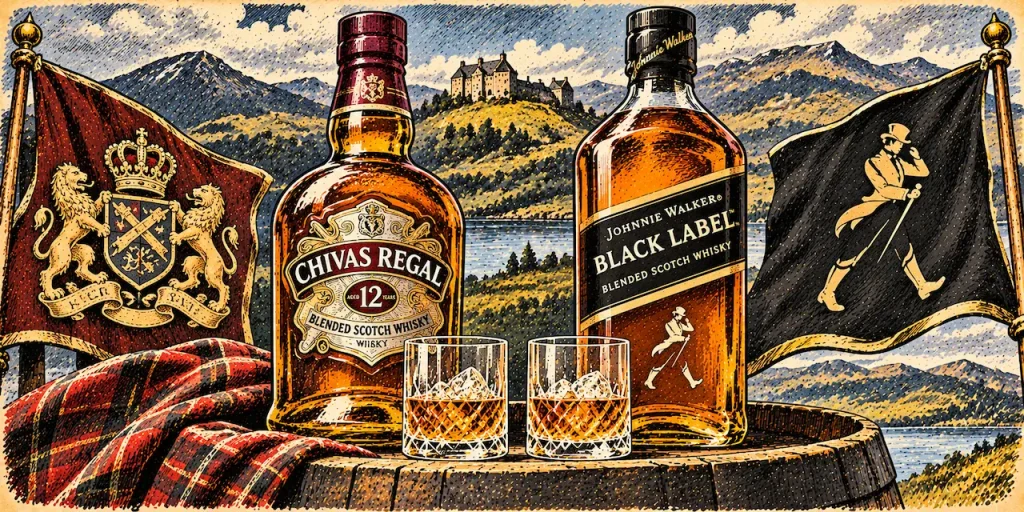
Blended Scotch is where the money in whisky is. Single malts get the press, but blends account for the large majority of Scotch sold worldwide, and two brands sit at the top of the premium tier: Johnnie Walker, owned by Diageo, and Chivas Regal, owned by Pernod Ricard. Diageo and Pernod are the two largest spirits companies on earth. Their flagship blends have been fighting for the same drinkers — in Asia, in Latin America, in duty free — for half a century. The fight has shaped what both whiskies taste like.
Two Victorian grocers
Both brands began as grocers’ shops. John Walker opened his in Kilmarnock, Ayrshire, in 1820 and sold blended whisky among the tea and spices; his son Alexander turned it into a business and his grandsons into a global one. James and John Chivas ran a luxury grocery in Aberdeen from the 1830s, supplying Balmoral and acquiring a royal warrant, and began blending their own whisky to sell to a wealthy clientele.
The difference in emphasis was there from the start. Walker’s was a volume business: Alexander Walker’s square bottle and slanted label were designed to stand out on a crowded shelf and pack efficiently into crates for export. Chivas was a prestige business, selling to people who already had money. Chivas Regal, launched in 1909 as a 25 year old blend aimed at the American market, was arguably the first luxury Scotch.
Those identities still hold. Johnnie Walker sells more than twenty million cases a year, the most of any Scotch by a wide margin. Chivas sells a fraction of that but at a consistently premium position. The blended Scotch style page sets out how the category works.
The home distilleries
Every big blend has a spiritual home malt. For Johnnie Walker it is Cardhu, in Speyside, which Diageo markets as “the heart of Johnnie Walker” and which supplies the honeyed, fruity core of the blend; Diageo also leans on Caol Ila for smoke, Clynelish for waxy texture and Glenkinchie for lightness, plus whatever else the blenders need from a portfolio of around thirty malt distilleries. See the Cardhu page for the distillery itself.
For Chivas Regal it is Strathisla, also in Speyside and one of the oldest continuously operating distilleries in Scotland (1786). Strathisla provides a rich, fruity, slightly oily malt that forms the backbone of every Chivas expression. Pernod’s Chivas Brothers division has about a dozen malt distilleries including The Glenlivet, Longmorn, Aberlour and Glen Keith, plus the giant Strathclyde grain distillery. The Strathisla page has the full story.
So both blends are Speyside-centred. Where they differ is what they add around that centre — and above all, how they treat smoke.
The smoke question
Johnnie Walker’s house style has always included peat. Red Label has a noticeable smoky edge; Black Label is built around a core of Islay and island malts that give it a signature wisp of smoke; Double Black turns that up. Smoke is what makes Walker identifiable blind, and Diageo has leaned into it.
Chivas Regal has essentially none. The Chivas style is soft, honeyed, creamy and fruity, with the emphasis on smoothness. The brand’s whole proposition — going back to the 1909 launch — is that it is the gentle, luxurious blend, and smoke has no place in that. It is a deliberate choice, and it is the single most useful thing to know when choosing between them.
The blending guide explains how a blender holds a house style like that steady across decades and thousands of casks.
The ranges
Both ranges are built around age statements, which is itself a point of difference from the no-age-statement trend elsewhere in Scotch. Our age statements guide covers what the number on a blend actually means (the youngest component).
- Johnnie Walker: Red Label (no age), Black Label 12, Double Black (no age), Green Label 15 (a blended malt, no grain), Gold Label Reserve (no age), Aged 18, Blue Label (no age, very old components), plus endless limited editions.
- Chivas Regal: 12, Extra 13 (several cask-finished variants), 15 (cognac cask finish), 18, 25, Ultis (blended malt), The Icon.
A useful structural observation: Walker’s range is wider at the bottom and more extreme at the top; Chivas’s range is tighter and more consistently premium. Chivas does not really have an equivalent to Red Label, and Walker’s Blue Label has no direct Chivas rival in price.
The grain whisky nobody mentions
Both blends are somewhere between 60 and 75 per cent grain whisky, and neither company talks about it much. It is worth doing so, because grain is where the two blends diverge quietly.
Diageo’s grain comes mostly from Cameronbridge in Fife, the largest grain distillery in Europe, which makes a very light, clean spirit from wheat. Johnnie Walker’s grain component is matured largely in refill casks and functions as a near-neutral backdrop; the character of the blend is carried almost entirely by the malts, which is why Walker tastes so clearly of Cardhu’s fruit and Caol Ila’s smoke.
Chivas Brothers’ grain is made at Strathclyde in Glasgow, and the Chivas blends use it differently. Strathclyde grain is given a share of good casks, including first-fill bourbon wood, and contributes vanilla, cream and softness in its own right. That is a large part of why Chivas 12 tastes so smooth: the grain is not just a filler but an active ingredient, delivering much of the creamy texture that defines the house style. Chivas’s Ultis, a blended malt with no grain at all, is instructive in reverse — without the grain it tastes much more assertive than anything else in the range.
The difference reflects a broader split in the industry. One school treats grain whisky as an economical base and lets the malts do the work; the other treats it as a flavour component in its own right and selects wood for it accordingly. Walker belongs to the first school, Chivas to the second, and once you know that, the character of each blend makes more sense.
How they taste
- Chivas Regal 12: honey, ripe apple, vanilla, a creamy, almost buttery texture, hazelnut, a soft and medium-length finish. Gentle to the point of being easy to overlook, which is what it is for.
- Johnnie Walker Black Label 12: dried fruit, orchard fruit, toffee, then smoke — not Islay-level, but present — with a medium body and a longer, drier, smoky finish. More assertive, more complex.
At 18, Chivas is richer and more sherried, with dark chocolate and dried fruit, and still no smoke. Walker 18 is smoother and more elegant than Black Label, with the smoke dialled down and the fruit up. At the top, Blue Label is a silky, honeyed, lightly smoky blend of very old whiskies; Chivas 25 is deep, dried-fruit-heavy and nutty.
Reading the market
The two companies compete most fiercely in the “status” markets where blended Scotch is a gift and a signal: China, India, Taiwan, Mexico, Brazil, Dubai duty free. In those markets, labels and bottle design matter as much as liquid, and both brands have been redesigned repeatedly to reflect that. Our guide to reading a label covers what the words on a blend actually guarantee and what they do not.
The honest view is that the two are closer in quality than their rivalry suggests. Chivas 12 and Walker Black are both competent, well-made blends that happen to be built for different palates. Neither is a sipping whisky by enthusiast standards; both are excellent in a highball.
Which one
If you want smoke, Walker; if you want softness, Chivas. If you want the better value at 18, that is a closer call and depends heavily on local pricing. Our tasting notes on both ranges are collected in the reviews as we publish them. The 15–18 year tier of both brands is often where the quality-to-price ratio looks best, though local pricing decides it.