Fifteen years ago Japanese whisky was a specialist’s interest. Then a series of international awards, a global boom in whisky generally and a shortage of aged stock turned it into the hottest category in spirits, with prices to match. The shelf today is confusing: two venerable companies with several distilleries each, a wave of new craft producers, and a long tail of bottles with Japanese names that contain whisky from Scotland or Canada. This guide sorts out who is who, what the labelling rules now say and where a newcomer should actually start.
The two houses
Japanese whisky was built by two men who began as colleagues and ended as rivals.
Suntory was founded by Shinjiro Torii, who built Japan’s first malt distillery at Yamazaki, near Kyoto, in 1923. He later added Hakushu in the mountains of Yamanashi (1973) and the Chita grain distillery. Suntory’s brands are Yamazaki and Hakushu as single malts, Hibiki as the flagship blend, Toki and Kakubin as everyday blends, and the Ao world-whisky blend. Our Yamazaki and Hakushu pages cover the two malt distilleries.
Nikka was founded by Masataka Taketsuru, the chemist Torii hired to set up Yamazaki, who had studied distilling in Scotland and married a Scottish woman. He left Suntory in 1934 to build his own distillery at Yoichi in Hokkaido, the cold northern climate he had wanted all along, and added Miyagikyo near Sendai in 1969. Nikka’s brands are Yoichi and Miyagikyo as single malts, Taketsuru as a blended malt, From the Barrel and Days as blends, and Coffey Grain and Coffey Malt from its old-style column stills. See the Yoichi and Miyagikyo pages.
Between them these two companies make the overwhelming majority of Japanese whisky and they shaped the national style, which is covered on the Japan region page.
What the Japanese approach actually is
Three things distinguish the Japanese method from the Scottish one it was modelled on.
First, variety within a distillery. Scottish distilleries make one spirit and get variety from casks; Japanese distilleries run multiple still shapes, yeasts, fermentation regimes and peating levels to make several spirits under one roof, because the big companies do not trade casks with each other the way Scottish blenders do. Our blending guide explains why that matters.
Second, attention to the highball. Whisky and soda is the national serve, and the big blends — Kakubin, Toki, Black Nikka — are designed for it.
Third, oak. Mizunara, Japanese oak, gives a sandalwood and incense note found nowhere else, and the major houses use it in their top expressions.
The third force: Kirin and the independents
Kirin, the brewer, has run the Fuji Gotemba distillery at the foot of Mount Fuji since 1973 and sells Fuji single grain and blended whiskies that are far less known than they deserve to be.
The real story of the last fifteen years, though, is the craft wave. Chichibu, founded by Ichiro Akuto in 2008 in Saitama, is the most celebrated: a tiny distillery whose single malts and Ichiro’s Malt blends command prices far above their age. The Chichibu page has its story. Behind it come Mars Shinshu and Mars Tsunuki, Akkeshi in eastern Hokkaido (deliberately modelled on Islay), Shizuoka, Kanosuke, Yuza, Saburomaru and dozens more. Many are young and most are small, so their bottles are limited and expensive. They are the future of the category and some are already excellent.
The labelling problem
For years, “Japanese whisky” could legally mean almost anything. Japan’s liquor tax law allowed whisky imported in bulk from Scotland or Canada to be bottled in Japan and sold with a Japanese name and no indication of origin. Several well-known brands on export shelves were made this way, trading on the category’s reputation without contributing to it.
In 2021 the Japan Spirits & Liqueurs Makers Association introduced voluntary standards: to be labelled Japanese whisky, the spirit must be fermented, distilled, aged for at least three years and bottled in Japan, from malted grain and Japanese water, at a minimum of 40 per cent. The rules are not law and some producers are not members, but the major companies have adopted them and the transition period ended in 2024. Our guide to reading a label covers what to look for; the short version is that a bottle which says “Japanese whisky” under the new standard is now meaningful, and one that avoids the phrase while using a Japanese name probably is not.
How Japanese whisky is drunk at home
Knowing how the Japanese drink their own whisky changes how you buy it, because the category was built for serves that most Western drinkers never consider.
The highball is first. Whisky and sparkling water over ice, in a tall glass, in a ratio of about one to three or four, is how most whisky in Japan is consumed. Suntory revived its fortunes in the late 2000s by marketing the Kakubin highball to younger drinkers in izakaya, and the drink is now ubiquitous: canned, on tap, in vending machines. Toki, Kakubin, Black Nikka and the standard Hibiki are all designed to work in a highball first and neat second. Judging them neat is to judge them for a job they were not built for.
Mizuwari — whisky with cold still water, typically one part whisky to two parts water over ice — is the gentler cousin, common with food. Oyuwari, whisky with hot water, is a winter serve that opens up aromatics in a way that surprises most newcomers; Nikka’s Taketsuru is particularly good this way.
Ice is treated seriously. Bars carve clear blocks into spheres or spears by hand so that the ice melts slowly and dilutes evenly, which is why a Japanese whisky highball tastes so different from one made with cloudy crushed ice. At home, a single large cube is enough to approximate the effect.
Neat, from a small tulip glass, is reserved for the aged single malts and the top blends. Even then, Japanese bartenders will often offer a splash of water, on the view that the whisky was blended to be drunk that way.
The price problem
Demand outran supply from about 2014. Yamazaki 12 and Hakushu 12 vanished and returned at two or three times their old prices; Hibiki 17 and 21 became collector pieces; the age-stated Nikka malts were withdrawn in 2015 and replaced with no-age-statement versions. Suntory has said aged stock will remain tight into the 2030s. The practical consequence is that the value in Japanese whisky now sits in the blends and the no-age-statement bottles, not in the famous twelves and eighteens.
Where to start
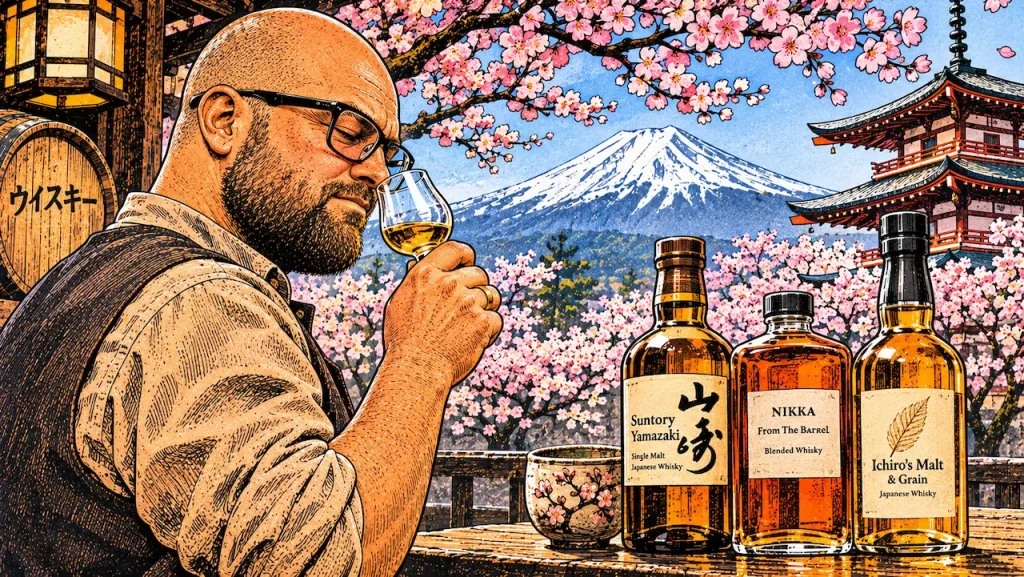
Nikka From the Barrel. A blend bottled at 51.4 per cent in a squat square bottle, rich and spicy and inexpensive. It is the best-value Japanese whisky on the market and has been for years.
Hibiki Japanese Harmony. The no-age-statement Suntory blend: honeyed, floral, light, elegant. It shows the Japanese blending style at a price still tied to reality.
Suntory Toki. Built for highballs; buy it for that and nothing else.
Nikka Coffey Grain. Made in a nineteenth-century-design Coffey still from corn; sweet, creamy, bourbon-adjacent and unusual.
Yamazaki or Hakushu Distiller’s Reserve. The no-age-statement single malts, a fair introduction to each house.
Nikka Yoichi or Miyagikyo (NAS). Yoichi is the peated, coastal, robust one; Miyagikyo is the soft, fruity one.
From there, the 12 Year Olds are worth buying at retail if seen, and Chichibu is worth trying once at a bar before committing to a bottle.
Our tasting notes are collected in the reviews as we publish them. Our view is that the Japanese houses make superb blends and that the obsession with the single malts has made people overlook them. Start with the blends, learn the house styles, and let the famous bottles come later.