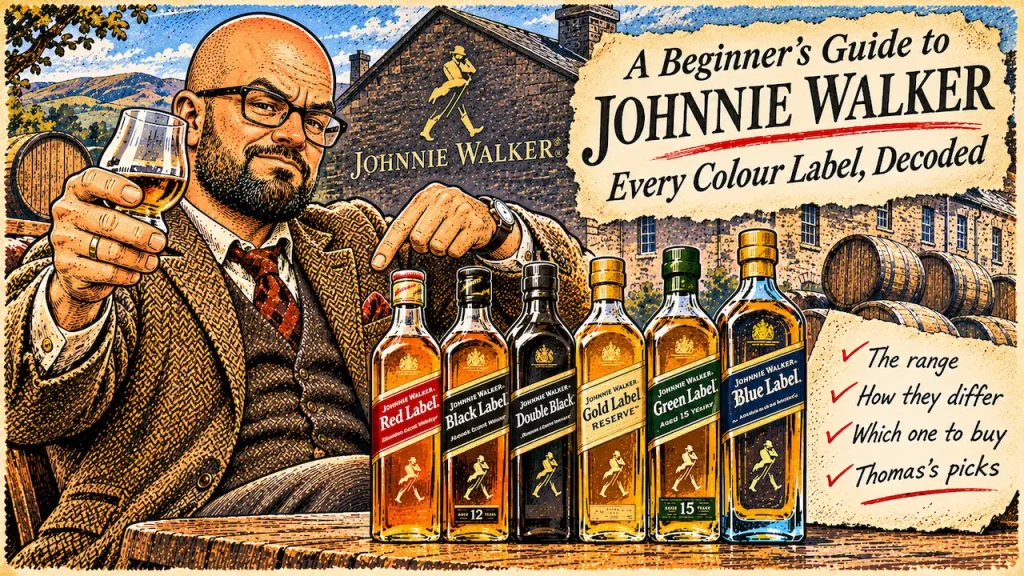
Johnnie Walker is the best-selling Scotch whisky in the world, and its range is colour-coded in a way that looks simple and is not. Red is the cheapest and Blue is the dearest, but between them sit labels that are not on a single ladder at all: a blended malt with no grain, a no-age-statement blend that sits above a twelve-year-old, and an eighteen that used to be called something else. This guide walks through every core expression, what is actually in it, and when you would choose it.
If you are new to whisky in general, our whisky for beginners guide is the right place to start before this one.
A little history, briefly
John Walker opened a grocer’s shop in Kilmarnock in 1820 and sold blended whisky under his own name. His son Alexander created the square bottle and the slanted label in the 1860s, both chosen to stand out and to pack efficiently for export. The Striding Man logo arrived in 1908, drawn by the cartoonist Tom Browne; the colour names were formalised around the same time, when “Old Highland Whisky” with a red or black label became Red Label and Black Label. The company passed to the Distillers Company in 1925 and sits today within Diageo, which has around thirty malt distilleries and the enormous Cameronbridge grain plant to draw on.
Every Walker is a blended Scotch — a mix of malt whiskies and grain whiskies — except Green Label, which contains only malts. The blended Scotch style page explains the category.
The house style
Three distilleries define Walker. Cardhu in Speyside brings a honeyed, apple-fruit core; Diageo calls it the heart of the blend, and the Cardhu page tells its story. Caol Ila on Islay brings the smoke — Walker’s signature wisp, more pronounced the further up the range you go until Blue Label, where it softens again. Clynelish from the far north brings a waxy, textured quality that gives the blends body. Around those three, the blenders use dozens more malts and a large proportion of grain whisky. The blending guide explains how a consistent house style is kept from a shifting cask inventory.
The result is identifiable blind: fruit, a little toffee, and smoke that is present but polite.
Red Label
The entry point and, by volume, the big one. Red Label carries no age statement and is built for mixing — the brand says so openly, and Walker highballs with soda or ginger ale are the intended use. It is the smokiest tasting of the lower tiers, with a sharp, peppery edge and a fairly thin body. Neat, it is rough. Over ice with soda, it is good. Treat it as a cocktail ingredient and it makes sense.
Black Label
The flagship, and the one most people mean when they say “Johnnie Walker”. Black Label carries a 12-year age statement, which means every whisky in it — malt and grain — is at least twelve years old. Our age statements guide explains why that minimum matters.
Black is dried fruit, toffee, a soft orchard sweetness and then a wave of smoke that lingers on a medium finish. It is a sipping blend at a mixer’s price, and it has been the benchmark for premium blended Scotch for a century. If you buy one Walker, buy this.
Double Black
Introduced in 2011 as a smokier, bolder take on Black. No age statement. The blend leans harder on Islay malts and uses more heavily charred casks, which adds a sweeter, toastier edge beneath the smoke. Drinkers who find Black Label’s peat too shy generally prefer this; drinkers who find peat unpleasant should stay with Black. Priced a little above Black.
Green Label
The outlier. Green Label is a blended malt — a mix of single malts with no grain whisky at all — aged at least fifteen years. Diageo discontinued it in 2012 and brought it back in 2016 after a sustained outcry, which tells you how regarded it is.
Green is built around four malts the company names on the label: Cardhu, Caol Ila, Clynelish and Linkwood. It is fuller, waxier and more complex than Black, with a fresher, greener fruit note and a rounder smoke. For many enthusiasts it is the best whisky in the range at any price, and it sits between Black and Gold in cost.
Gold Label Reserve
A no-age-statement blend introduced in 2013, replacing the old Gold Label 18. It is positioned as the “celebration” whisky and the blend is softer and sweeter than Black, with honey, cream and tropical fruit and very little smoke. It is well-made and pleasant, but it is the expression most often criticised for its price relative to Green, which costs less and offers more.
Aged 18
Formerly sold as Platinum Label, renamed in 2016 to the plainer Johnnie Walker Aged 18. Every component is at least eighteen years old. It is elegant rather than powerful: dried fruit, vanilla, soft oak, a gentle, rounded smoke and a long finish. This is the point in the range where the blend starts to feel like a special occasion, and it is the sensible stopping point for most drinkers before Blue.
Blue Label
Launched in 1992, no age statement, built from rare and very old casks — Diageo says fewer than one in ten thousand are good enough. Blue is velvety and honeyed, with dried fruit, hazelnut, a little dark chocolate and a smoke that is more a memory than a presence. It is an extremely accomplished blend. Whether it is worth four or five times the price of the 18 is a matter of taste and of how much the bottle, the box and the gesture are part of what you are buying. In the markets where Walker sells most — Asia and Latin America — those things matter a great deal.
How to drink them
The range was designed with serves in mind, and knowing them helps.
Red Label is at its best lengthened: one part whisky to two or three parts soda or ginger ale, over plenty of ice, with a wedge of lime. Diageo has spent a great deal of money promoting the Johnnie Walker highball in Asia and it works because the smoke and pepper survive dilution where a softer blend would vanish.
Black Label is the versatile one. Neat or with a splash of water it shows its fruit and smoke properly; over ice it loses a little complexity but stays pleasant; in a Rob Roy or a whisky sour it holds its own against the sweet and sour elements better than most blends. Double Black is the better choice for an Old Fashioned if you like smoke in the glass.
Green Label, Gold Reserve, the 18 and Blue should be drunk neat, from a tulip-shaped glass, at room temperature. Ice closes down the aromatics that you are paying for. A few drops of water in the 18 and Blue can open them up; adding more than that is wasteful.
A note on temperature: Walker’s marketing has at times pushed Blue Label served from the freezer, which produces a thick, syrupy texture and almost no aroma. It is a sensory novelty rather than a way to taste the whisky.
Beyond the core
The range sprawls past these seven. There have been flavoured variants and finishes (Red Rye Finish, Black Label Sherry Edition, Ruby Reserve), Game of Thrones and Blade Runner tie-ins, the Blue Label Ghost and Rare series built around closed distilleries, and the John Walker & Sons luxury line at the very top. Most are curiosities. The core seven are what matter.
Which to buy
For mixing: Red. For your first sipping Scotch: Black. If you like smoke: Double Black. If you want the best whisky in the range: Green. For a gift that will impress: 18, unless the recipient would notice the difference between 18 and Blue — in which case they already know what they want.
Our tasting notes are collected in the reviews as we publish them. Our view: Black and Green are the value points, Gold is the weak link, and Blue is excellent but priced for a different purpose. For a sense of the malts underneath it all, the Caol Ila and Clynelish distillery pages are where to start.