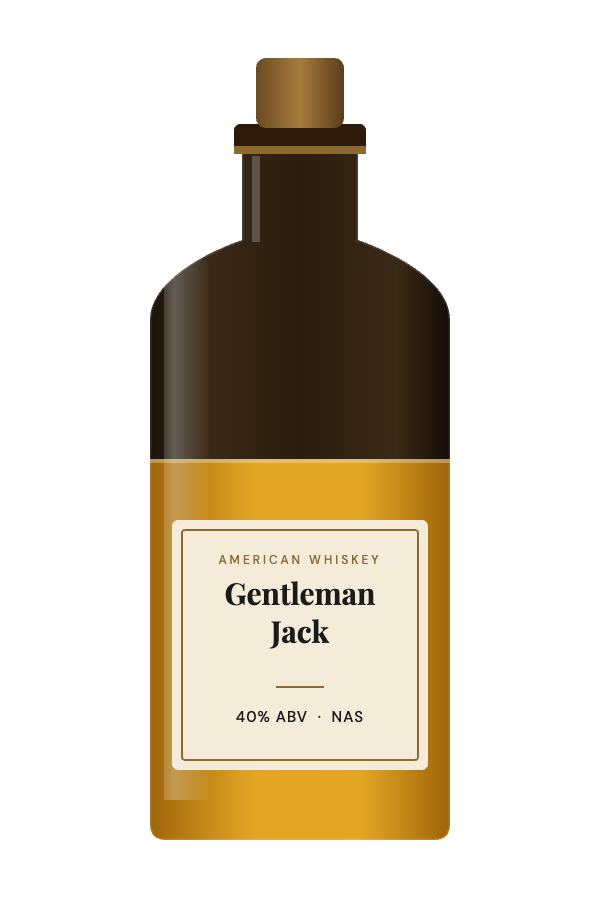
Gentleman Jack is Jack Daniel’s for people who think Jack Daniel’s is a bit rough. It’s the same distillery, the same basic recipe, and one extra step that’s supposed to make it smoother.
That one extra step is the whole selling point, so it deserves a close look.
The extra charcoal filtering
Jack Daniel’s is made in Lynchburg, Tennessee, and the Tennessee style is defined by a process called charcoal mellowing. The new spirit is filtered through a thick layer of sugar maple charcoal before it goes into the barrel. Gentleman Jack does that twice. The whiskey is filtered once before ageing, as usual, and again after it comes out of the barrel.
The idea is that the second pass removes a little more of the harshness. The brand was introduced in 1988, and is bottled at 40%. The company is Brown-Forman, and there’s no age statement.
My bias
Smooth is what I look for, and Gentleman Jack is sold as the smooth Jack. That means it’s a bottle I’m inclined to like on paper. What I want to check is whether it feels distinct from the Old No. 7, or whether the difference is mostly in the pitch.
Trying it
I tried this neat and then poured an Old No. 7 next to it. I expected Gentleman Jack to be smoother, and it is. The difference is clear but not huge.
Nose: Banana, vanilla and caramel. It smells sweet and soft. A bit less sharp than Old No. 7, with no harsh edges.
Palate: Smooth and sweet, with a light spice and a hint of oak. It feels softer and rounder than the standard Jack. At 40% it’s easy to drink, though a bit light. It’s what I’d call a good everyday sipper.
Finish: Short to medium, soft and clean. It fades gently. A bit of ice worked fine.
The Jack Daniel family
Old No. 7 is the classic. Gentleman Jack is the smoother one. Single Barrel Select is the premium step up. Tennessee Fire and Tennessee Honey are flavoured. If you like Gentleman Jack and want a bit more depth, the Single Barrel is where people usually go next.
Alternatives
George Dickel No. 12 is the other big name in Tennessee whiskey, and it’s drier. Maker’s Mark is a soft bourbon from Kentucky. Uncle Nearest 1856 is a step up in price and strength. Gentleman Jack is the easy one.
Value
A 70 cl bottle usually costs about £26 in the UK. A few pounds above Old No. 7, and I think it’s worth it.
It’s usually priced a bit above Old No. 7. Whether the second filtration is worth the extra depends on how you taste it.
Who it is for
It’s for people who want a smooth whiskey for sipping or mixing, and for those who find the standard Jack Daniel’s a bit sharp. If you already like Old No. 7, you may not see much need to upgrade.
Is it worth the extra?
The question I had was whether the second filtration is worth paying for. I’d say it is, but only just. The difference is subtle, a bit of extra softness and a bit less sweetness. You notice it side by side, and less so if you drink it alone.
For the Jack Daniel’s skeptic
If you’ve tried Old No. 7 and found it too sweet or too thin, this is worth a go. It’s smoother, and it feels more grown up. It doesn’t change what Jack Daniel’s is, but it tidies it.
I’d buy it as a step up for friends who like Jack. For myself, I’d go for something with a bit more depth.
I’d say it’s worth keeping an eye on this bottle next to the Old No. 7. When the two are on the table together, you can see how much difference a little extra care makes. It’s not a revolution, and it’s a clear improvement. That’s enough for me to recommend it.
A last practical tip. If you’re trying it next to Old No. 7, use the same glass type and the same measure for both. The difference is small, and any change in the setup can hide it. Done properly, the extra smoothness is easy to spot.
Verdict
Yes. It’s smooth and easy, and I’d buy it again. If you like Old No. 7 but find it a bit rough, this is the one.

Banana, vanilla and caramel
Smooth and sweet, light spice and a hint of oak
Short to medium, soft and clean
Smooth and sweet, a clear step up from Old No. 7. Easy to drink, if a bit light.

Thomas Grønvold is the founder of Caskable and a whisky enthusiast who believes the best way to learn about whisky is simply to drink it, compare it, and stay curious. From supermarket favourites to bottles from distilleries around the world, he writes about what he actually tastes and experiences, without pretending you need to be an expert to enjoy a good dram.
View profile →