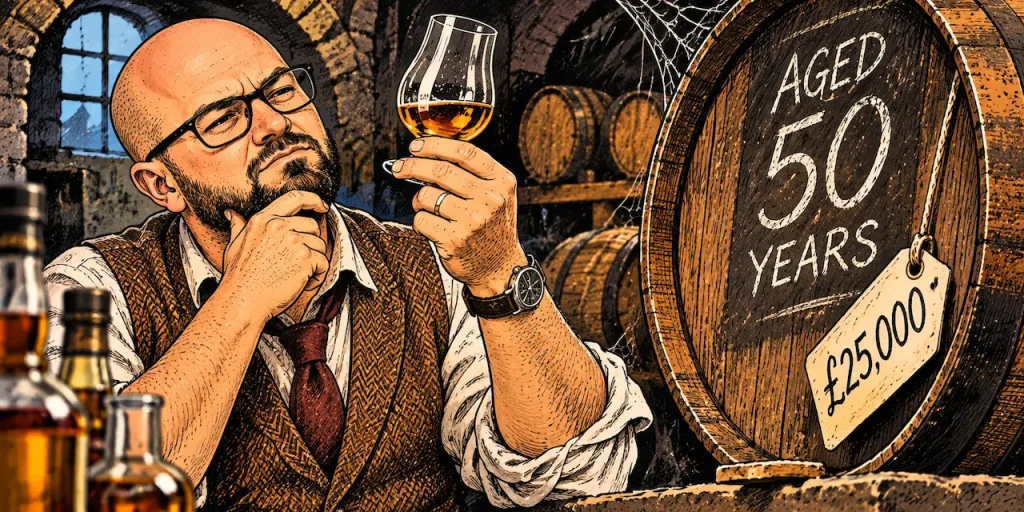
There’s a peculiar sort of person in the whisky world who can tell you exactly how old a bottle is, what it costs and how many were produced, but struggles to explain whether the bloody thing tastes any good. He’ll happily spend twenty minutes discussing a thirty-year-old single malt, yet ask whether he’d actually buy another bottle and suddenly the conversation becomes rather complicated.
I’ve never understood the obsession. Age matters in whisky, of course, but we’ve developed an unfortunate habit of treating it as a quality rating. A twenty-five-year-old Scotch must be superior to an eighteen-year-old, which must be better than a twelve-year-old. Anything without a number on the label is apparently suspicious.
It’s a convenient arrangement for distilleries selling expensive whisky, but not necessarily for those of us buying it.
Some remarkable spirits have spent decades developing in Scottish warehouses, and I have enormous respect for the craftsmanship involved. What I question is the assumption that another ten years in a wooden barrel automatically makes something worth drinking.
What age actually does to whisky
Maturation is one of the most important stages of whisky production. Freshly distilled spirit interacts with the oak, absorbing compounds that contribute flavours such as vanilla, spice, coconut and toasted wood. At the same time, chemical reactions alter existing aromas, while some of the harsher characteristics of young spirit gradually diminish.
But maturation isn’t a straightforward process of improvement. Different barrels behave differently, and a whisky that tastes excellent after twelve years might become excessively woody if left for another decade.
The type of cask matters enormously. A first-fill American oak barrel can contribute substantial vanilla and toasted flavours relatively quickly, while a refill cask may allow more of the original distillery character to survive. Sherry-seasoned casks introduce another set of influences, often associated with dried fruit, spice and richness.
Even two barrels filled with identical spirit on the same day can develop differently. Warehouse location, temperature, humidity and the individual properties of the wood all influence the result.
Then there’s evaporation, the famous angel’s share. Whisky slowly escapes through the barrel during maturation, with losses varying according to climate and storage conditions. A distillery keeping whisky for thirty years must accept that a meaningful proportion of its original stock will never reach a bottle.
This is one reason old whisky costs more to produce. It doesn’t explain why every old whisky should be considered exceptional.
The £45 bottle against the £350 bottle
Imagine two single malts from the same distillery. One is twelve years old and costs £45; the other is twenty-five and costs £350. The older expression has spent more than twice as long maturing, but costs nearly eight times as much.
That difference reflects several things: storage, evaporation, tied-up capital, scarcity and, inevitably, marketing. What it doesn’t provide is any guarantee that the drinking experience will be eight times better, assuming such a thing could even be measured.
Older whisky can develop extraordinary complexity. It can also become dominated by oak, losing the fruit, cereal or smoky character that made the original spirit interesting. The distiller’s challenge is to select casks at the right moment, not simply wait until the number on the label looks impressive.
I would rather spend £45 on a beautifully balanced whisky than £350 on something whose most interesting characteristic is its date of birth.
That’s not an argument against expensive whisky. It’s an argument for demanding more from it.
If a distillery wants several hundred pounds for a bottle, I want to know what makes the spirit special. Tell me about the casks, the production and the flavours. Don’t simply point at the age statement and expect me to reach for my wallet.
Why bourbon makes the age argument even sillier
The limitations of age statements become particularly obvious when comparing Scotch with American whiskey.
Bourbon must mature in new charred oak containers, unlike Scotch, which is commonly matured in casks previously used for bourbon, sherry or other drinks. Fresh oak can contribute powerful vanilla, caramel and toasted flavours, while Kentucky’s seasonal temperature variations create maturation conditions quite different from those in Scotland.
This doesn’t mean bourbon universally matures faster, but it does mean that twelve years in a Kentucky warehouse and twelve years in a Scottish warehouse are not equivalent experiences.
Extended maturation in new oak can be particularly unforgiving. Too much wood influence may leave a bourbon bitter, dry or excessively tannic. Some excellent American whiskeys are bottled relatively young, while others benefit from considerably longer ageing.
I find it strange that enthusiasts who understand these differences still insist on comparing whiskies primarily by their age statements. The number is useful information, but without knowing how the spirit was produced and matured, it tells only a fraction of the story.
No age statement? No problem.
No-age-statement whisky, commonly called NAS, has become another source of unnecessary suspicion. Some drinkers assume that removing the age statement is a way for distilleries to disguise younger, cheaper stock.
Sometimes that suspicion is reasonable. Without a declared minimum age beyond the legal requirements, producers have greater flexibility to use younger whisky, which can help manage inventories and production costs. Consumers are entitled to question whether a new NAS release represents good value, particularly when it replaces an age-stated expression at a similar price.
But the absence of a number isn’t evidence of poor quality.
Ardbeg Uigeadail is a good example. It combines the distillery’s heavily peated character with sherry-cask influence, creating a distinctive expression without relying on an age statement. Aberlour A’bunadh similarly emphasises its powerful, sherry-driven character rather than a declared maturation period.
Both demonstrate that cask selection and blending can produce interesting whisky without advertising the age of the youngest component.
I wouldn’t give either a free pass simply because of its reputation. A whisky should justify its price through what’s in the glass, whether it carries an age statement or not.
Can you actually taste how old a whisky is?
Experienced drinkers can sometimes recognise characteristics associated with extended maturation. Older whiskies may show deeper oak, dried fruit, leather or spice, while younger expressions can retain more obvious cereal and fermentation notes.
But identifying age from flavour alone is considerably more difficult than some enthusiasts suggest. A young whisky from an active cask can appear richer and more wood-driven than an older expression matured in relatively inactive oak.
Blind tasting is an excellent way to challenge assumptions. Pour a few whiskies into identical glasses, conceal their identities and judge them before seeing the labels. It’s remarkable how much less important reputation becomes when you don’t know what you’re drinking.
The exercise won’t tell you everything about a whisky’s production, but it can reveal something more immediately useful: which one you actually prefer.
And if the cheaper bottle comes out ahead, you’ve saved yourself some money. Hardly a tragedy.
So, how old should a good whisky be?
There isn’t a universal answer. For Scotch, I think the twelve- to eighteen-year range is a sensible place to explore, with plenty of established distilleries offering mature expressions before prices climb into luxury territory. But excellent whisky exists on either side of that range, and bourbon operates under different maturation conditions altogether.
My preference is to understand the style before worrying about the age. Is the whisky smoky or fruity? Is it dominated by oak, or does the original spirit still come through? Has the distillery achieved something distinctive, or merely produced another expensive bottle with an impressive number?
Those questions tell me far more than an age statement in isolation.
I don’t begrudge anybody spending serious money on a thirty-year-old single malt. Some are extraordinary, and the patience required to produce them deserves recognition. What irritates me is the suggestion that the number alone should command respect.
Whisky is made to be drunk, not admired like a certificate of achievement. I want character, balance and something interesting enough to make me consider pouring another glass.
So the next time somebody proudly announces that their whisky is twenty-five years old, I’ll happily listen to the story behind it.
But I still want to know one thing.
Does it taste any bloody good?
Because if it doesn’t, all you’ve got is a very old disappointment in an expensive bottle.