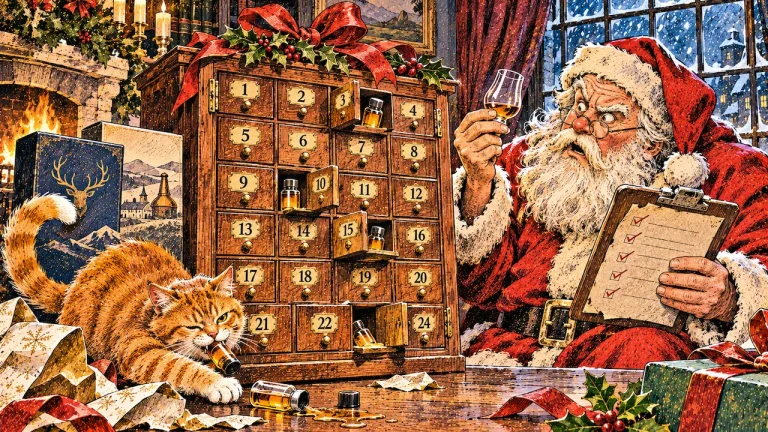
I love a good whisky. Give me an interesting bottle, a comfortable chair and an evening with nowhere particularly important to be, and I’m perfectly happy. I’ll read about the distillery, investigate the casks and probably spend longer than necessary trying to understand why one whisky tastes completely different from another. It’s a fascinating subject, and the more I learn about it, the more I appreciate the people who make the stuff.
What I can’t stand is the pompous bastard who insists on turning the whole experience into a bloody examination.
You know the type. He doesn’t simply enjoy whisky; he understands whisky, and he’s terribly keen that everybody else should know it. Order something ordinary and he’ll explain why you’ve made a mistake. Add ice and he’ll look as though you’ve just relieved yourself in the baptismal font. Mention that you quite like Jack Daniel’s and you might as well announce that you wash your socks in the dishwasher.
It’s an extraordinary amount of fuss over a drink.
I’m not suggesting whisky shouldn’t be taken seriously. Quite the opposite. There’s real skill involved in making good whisky, and understanding the differences between distilleries, casks and production methods makes drinking it considerably more interesting. But somewhere along the line, a section of the whisky community has confused knowledge with superiority.
And frankly, it’s bollocks.
When enjoying whisky became a competitive sport
Whisky has always attracted collectors and connoisseurs, but the modern industry has become remarkably good at encouraging people to treat drinking as a demonstration of status. A bottle is no longer simply something to enjoy. It’s an expression of your sophistication, purchasing power and ability to pronounce the names of remote Scottish villages.
Look at the way some premium whiskies are presented. Heavy glass decanters, polished wooden boxes, elaborate certificates and limited-edition labels informing you how extraordinarily fortunate you are to have been allowed to spend £500. By the time you’ve finished admiring the packaging, opening the bottle feels rather like vandalising a museum exhibit.
I enjoy a beautifully presented bottle as much as anybody, but I do occasionally wonder whether some producers have forgotten what they’re selling. Whisky is supposed to be consumed. The wooden box is unlikely to improve the flavour, however much mahogany they’ve managed to squeeze into it.
The same attitude has found its way into ordinary conversations. Ask somebody for a recommendation and you might receive a lecture about chill filtration, cask strength and the superiority of obscure independent bottlings. All useful subjects, certainly, but perhaps not what the poor fellow had in mind when he asked for something decent under £50.
There’s a difference between sharing enthusiasm and holding an audience hostage. Unfortunately, some whisky enthusiasts seem unable to tell where one ends and the other begins.
The ridiculous business of tasting notes
I enjoy reading good tasting notes. If somebody describes a whisky as having vanilla, dried fruit, gentle smoke and a peppery finish, I have a reasonable idea of what to expect. It’s useful information, particularly when I’m deciding whether a bottle deserves my money.
But whisky descriptions can become spectacularly pretentious.
Apparently, some whiskies smell of freshly polished antique furniture, damp autumn leaves, expensive leather, tropical fruit and the inside of a Victorian gentleman’s study. All at once, presumably. I’m occasionally surprised nobody has detected a faint suggestion of unpaid school fees and disappointment in the British Empire.
Now, flavour perception is genuinely complicated. Fermentation produces esters and other aromatic compounds, distillation influences which survive, and maturation introduces further characteristics from the wood. People also associate smells with their own experiences, which explains why one person might detect dried apricots while another thinks of something entirely different.
I have no objection to unusual descriptions when they’re sincere. If a whisky genuinely reminds somebody of their grandmother’s kitchen, fair enough. What irritates me is the apparent need to produce increasingly elaborate tasting notes to demonstrate that one’s palate is more sophisticated than everybody else’s.
Sometimes a whisky tastes of vanilla, oak and a bit of spice. That’s perfectly acceptable. You don’t need to invent six exotic fruits and a smoking jacket to make it interesting.
I’d rather read an honest review explaining that a whisky is pleasant but slightly dull than three paragraphs of extravagant tasting poetry that never quite establish whether the bloody thing is worth buying.
Expensive whisky isn’t automatically good whisky
Another irritating habit is treating price as a reliable measure of quality. A £40 bottle is considered entry-level, £150 apparently signals serious appreciation, and anything approaching £1,000 must be extraordinary. At that price, I assume the distillery sends somebody round to polish your shoes.
Of course, expensive whisky can be magnificent. I’ve no objection to paying more for something genuinely special, and producing old whisky involves considerable expense. Distilleries must store barrels for decades, absorb evaporation losses and tie up capital in spirit they cannot sell until years later. Scarcity also matters, particularly when only a limited number of suitable casks remain.
But the price of a bottle reflects much more than its flavour. Branding, packaging, collector demand and perceived prestige can all add substantial premiums. A thirty-year-old single malt might be exceptional, but it might also have spent rather too long extracting tannins from its barrel.
I’ve argued before that whisky age statements are useful information, not a quality ranking. The same principle applies to price. A well-made twelve-year-old Scotch can be more enjoyable than a much older expression, just as an inexpensive bourbon can offer more character than something presented in a box resembling a small coffin.
I have no problem with collectors spending extraordinary amounts on rare bottles. It’s their money, and collecting is a perfectly respectable hobby. But collecting expensive whisky and enjoying good whisky are not necessarily the same activity.
If I prefer a £40 bottle to one costing £200, I’m not going to apologise for it. I’ve simply found something I enjoy and saved myself £160, which strikes me as a rather satisfactory outcome.
For God’s sake, let people put ice in their whisky
Few things expose a whisky snob faster than watching somebody drop an ice cube into a glass of Scotch. The expression of horror can be quite remarkable, as though generations of Scottish distillers have suddenly risen from their graves to register a formal complaint.
There are legitimate reasons to consider how whisky is served. Temperature affects aroma, dilution changes the concentration of alcohol and other compounds, and adding water can alter the balance of flavours. Cooling a whisky may suppress certain aromas, while a little water can make others easier to detect.
That’s interesting science. It isn’t a moral code.
I generally think a good whisky deserves to be tried neat, particularly when I’m unfamiliar with it. I want to understand what the distillery has produced before changing anything. But if somebody prefers a little water, a large cube of ice or a highball, I can’t see why that should concern anybody else.
The same applies to cocktails. Whisky has been used in mixed drinks for generations, and the Old Fashioned, Manhattan and Whisky Sour are hardly inventions of people who don’t appreciate spirits.
And yes, there’s room for a Jack and Coke. I probably wouldn’t pour cola into an expensive single malt, but if somebody has bought a bottle of Jack Daniel’s and wants to mix it with Coca-Cola, why should I object? The distillery has been paid, the customer is happy and nobody has suffered any identifiable harm.
Apart from the chap at the next table, apparently, who’s now having a nervous breakdown over the ice.
Single malt isn’t a certificate of superiority
One of the more persistent misconceptions in whisky is that single malt Scotch is inherently superior to blended Scotch. The reasoning usually seems to be that single malt sounds more prestigious, while blends are associated with familiar supermarket bottles.
But these are production categories, not quality ratings.
Single malt Scotch is made from malted barley at one distillery using pot stills, while blended Scotch combines malt and grain whiskies from different distilleries. Producing a good blend requires considerable skill, particularly when the blender must maintain a consistent character using casks that naturally vary from one batch to another.
Johnnie Walker Black Label, for example, combines whiskies from different Scottish distilleries to create its familiar balance of fruit, sweetness and smoke. It isn’t automatically inferior because its components come from more than one place.
I often find individual distillery styles particularly interesting, and single malts offer plenty of opportunities to explore them. But that preference doesn’t mean blending is an inferior discipline.
The same snobbery appears with American whiskey. Jack Daniel’s is routinely dismissed because it’s popular, widely available and frequently mixed with Coke. Old No. 7 has limitations, certainly, but the distillery’s Single Barrel expressions demonstrate that there’s considerably more happening in Lynchburg than its familiar black-label bottle might suggest.
If a whisky is poorly made, overpriced or simply boring, I’ll happily criticise it. What I won’t do is dismiss it because the label isn’t fashionable among people who spend their weekends arguing about cask finishes.
Knowing your whisky should make you better company
Here’s what makes the whole business so frustrating: learning about whisky really does make drinking it more enjoyable.
Understanding how peat smoke develops during malting, why American oak contributes vanilla and coconut, or how traditional Irish pot still whiskey differs from Scottish single malt opens up an enormous world of flavours and production traditions. You begin recognising characteristics you might previously have overlooked, and comparing different bottles becomes much more interesting.
That’s precisely why I enjoy writing about whisky. There’s history, chemistry, geography and craftsmanship involved, and an extraordinary amount still worth discovering.
But knowledge ought to make somebody more interesting to talk to, not less.
If a beginner asks why one whisky tastes smoky and another doesn’t, explain how peat is used during malting. If somebody wants to understand the difference between bourbon and Scotch, tell them about the grains, barrels and production rules. You can have a genuinely interesting conversation without making the other person feel as though they’ve wandered into the wrong examination room.
Nobody is born knowing the difference between a pot still and a column still. And nobody should need to apologise for not knowing.
I have far more time for somebody who’s genuinely curious about whisky than for a self-appointed expert who uses every conversation to demonstrate how much more he knows than everybody else.
The point of expertise, surely, is that you have something worth sharing.
The whisky industry has encouraged the nonsense
It would be unfair to blame enthusiasts entirely. Distilleries have spent decades encouraging consumers to associate age, rarity and elaborate packaging with prestige, and the luxury end of the market has become increasingly sophisticated at selling exclusivity.
Some limited releases are marketed as much towards collectors as drinkers. Bottles are purchased, displayed and traded without ever being opened, while auction prices become part of the publicity surrounding particular distilleries.
There’s nothing inherently wrong with collecting whisky. People collect watches, wine, paintings and all sorts of other expensive objects. But a bottle’s rarity tells me very little about whether I’d enjoy drinking it.
What concerns me is the way that culture can influence ordinary whisky drinkers. When every advertisement suggests that sophistication comes from owning something older, rarer or more expensive, it’s hardly surprising that some enthusiasts begin treating their collections as evidence of personal superiority.
I want to know what makes a whisky interesting. Tell me about the distillery, the spirit, the cask and the decisions behind the final bottling. Explain why it tastes the way it does and whether the price represents reasonable value.
I don’t particularly care whether owning it will impress somebody I’ve never met.
Good whisky deserves serious attention. Its drinkers don’t.
I don’t believe every whisky is equally good, and I have no intention of pretending otherwise. Some are beautifully balanced, complex and genuinely memorable. Others are dull, poorly integrated or absurdly expensive for what they offer.
Taking whisky seriously means being prepared to make those distinctions. It means understanding production, questioning marketing claims and explaining why one bottle succeeds where another falls short.
What it doesn’t require is treating the person drinking it as an extension of the product.
Somebody enjoying an inexpensive blend might be having a wonderful evening. Somebody drinking a rare single malt might be disappointed, even if he’s too proud to admit it. Neither situation tells us anything particularly useful about the character or intelligence of the person holding the glass.
Whisky has an extraordinary variety of traditions to explore, from Scotland and Ireland to America, Japan, India and Taiwan. There’s enough history and craftsmanship involved to keep an interested person occupied for decades without turning every conversation into a contest.
I’d rather spend an evening drinking perfectly ordinary whisky with interesting people than exceptional whisky with somebody determined to explain why my glassware is wrong.
And that’s really the point. I love good whisky, and I intend to keep learning about it, writing about it and occasionally spending more money on a bottle than is strictly sensible. But I refuse to treat drinking as a performance designed to impress strangers.
By all means, take your whisky seriously. Learn about distilleries, explore unusual bottlings, challenge lazy reviews and develop your own opinions. There’s nothing wrong with being knowledgeable, and there’s certainly nothing wrong with having high standards.
Just don’t become the insufferable bastard who makes everybody else wish they’d ordered a beer.
A good whisky should improve an evening. If your whisky knowledge is making everybody else’s evening worse, you’ve rather missed the point.