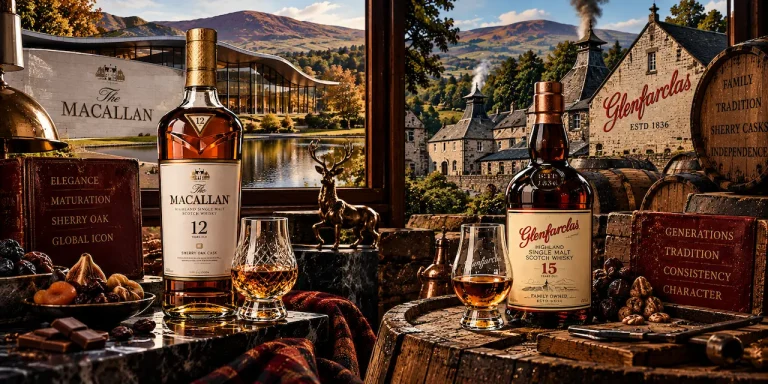
Glenfiddich and The Glenlivet are the two best-selling single malt Scotch whiskies on earth, trading the top spot between them depending on the year and who is counting. They are both in Speyside, both founded by men named for their glens, both made from unpeated malt and both sold in a 12 Year Old that sits at the entry point of single malt for millions of drinkers. People confuse them constantly. They should not, because they are built on very different ideas.
Two origin stories
The Glenlivet’s story is the founding story of legal Scotch. George Smith, a farmer and illicit distiller in the glen of the River Livet, took out the first licence under the 1823 Excise Act in 1824 — a move so unpopular with his still-illegal neighbours that he carried a pair of pistols for years. The name “Glenlivet” became shorthand for quality, to the point where dozens of distilleries appended it to their own names until a 1884 court ruling gave Smith’s heirs the right to the definite article: The Glenlivet.
Glenfiddich came sixty years later. William Grant, who had worked at nearby Mortlach for two decades, built his own distillery by hand with his sons in 1886–87 using second-hand stills bought from Cardhu. The family still owns it, which makes William Grant & Sons one of the very few large independent, family-owned producers left in Scotch. The Glenlivet, by contrast, has been owned by Chivas Brothers (now part of Pernod Ricard) since the 1970s.
That ownership difference shapes the brands. Glenfiddich has been free to make long-term decisions, such as being the first single malt to be marketed as such outside Scotland in the 1960s. The Glenlivet has the resources of one of the world’s two largest spirits companies behind it and has used them to expand capacity relentlessly.
Both histories are on the Glenfiddich and Glenlivet distillery pages.
Water and location
Glenfiddich draws from the Robbie Dhu spring in Dufftown. The Glenlivet uses Josie’s Well, a mineral-rich spring in a far more remote spot some twenty miles south. The marketing of both leans hard on the water, and the honest view is that the water matters less than the stills — but the locations say something. Glenlivet is high, cold and isolated, which is why the glen was such a haven for illicit distilling. Dufftown is a whisky town, with half a dozen distilleries within a short walk.
The Speyside region page explains why this corner of Scotland ended up with more distilleries than anywhere else.
The stills
This is the real divide.
Glenfiddich runs a large number of small stills — twenty-eight or so across two still houses, many of them roughly the same shape William Grant bought in the 1880s. Small stills mean more contact between spirit vapour and copper, which strips sulphur and produces a clean, light, fruity spirit. The distillery deliberately kept the still size when it expanded, multiplying them rather than enlarging them, to protect the character.
The Glenlivet runs tall, broad, lantern-shaped stills — fourteen of them, and more since the 2018 expansion. Tall stills produce a lot of reflux: heavier vapours condense and fall back before they can reach the condenser. The result is a very light, delicate spirit, floral and estery.
So both are light, but in different ways. Glenfiddich’s new-make is pear-fruity with a hint of cereal weight. The Glenlivet’s is more floral, almost perfumed, with a softer, thinner texture. Our guide to fermentation and distillation goes into why still shape has such an outsized effect.
Wood
Glenfiddich has built its modern reputation on wood experiments. The 12 Year Old is matured in a mix of ex-bourbon American oak and ex-sherry European oak; the 15 Year Old uses a solera vat that is never fully emptied; the 14 Year Old Bourbon Barrel Reserve is finished in new charred oak; the Experimental Series has included IPA cask and ice-wine finishes. There is an in-house cooperage, which is rare, and an evident willingness to try things.
The Glenlivet has been more conservative with its core range. The 12 Year Old is matured mainly in American oak, which reinforces the distillery’s light, vanilla-and-apple profile. The 15 Year Old adds a French oak finish; the 18 uses a sherry component. Recent years have brought a Caribbean Reserve (rum cask) and a 14 Year Old cognac cask, so the house is catching up, but the identity remains “clean, fruity, not too much cask”.
Our cask finishes guide explains what those secondary casks actually contribute.
Scale, and the race to be biggest
Both distilleries have expanded to a size that would have been unimaginable to their founders, and the race is part of the story.
Glenfiddich was already large by the 1960s, when the Grant family’s decision to export single malt gave it a head start of roughly a decade on every rival. Through the 1970s and 1980s it was the best-selling single malt in the world by a comfortable margin. Capacity today is around 20 million litres of pure alcohol a year, making it one of the two or three largest malt distilleries in Scotland.
The Glenlivet spent decades in second place and Pernod Ricard has spent the last twenty years closing the gap. A 2010 expansion added six stills; a 2018 expansion added a further six and lifted capacity to around 21 million litres, with planning permission in place to go further. In several recent years The Glenlivet has reported higher volumes than Glenfiddich, particularly on the strength of its position in the United States, where it is the leading single malt by some distance.
Which is “biggest” depends on the year, the measure (volume versus value, global versus US) and who is reporting. The honest answer is that they are neck and neck, which is why the rivalry persists. For the drinker it matters only in one respect: at this scale, consistency is engineered with enormous care, and the 12 Year Old you buy in Oslo is the 12 Year Old you buy in Singapore.
How the 12s compare
Put the two flagship bottlings side by side and the differences are obvious once you know to look.
- Glenfiddich 12 Year Old is pear — specifically fresh pear, the distillery’s signature — with a cereal, biscuity weight underneath, a little oak and a subtle sherry-cask richness on the finish. It is slightly fuller in body and has more going on.
- The Glenlivet 12 Year Old is green apple, white flowers, vanilla and honey, with a soft, silky texture and a short, clean finish. It is the more delicate of the two and, to some palates, the simpler.
Neither has any peat. Both are bottled at 40 per cent and are chill-filtered and coloured, which is standard at this level.
Moving up the range the gap widens. Glenfiddich’s 15 solera and 18 are richer and more sherried; The Glenlivet’s 15 and 18 stay fruit-led with a bit more oak. Glenfiddich’s older expressions (21, 23, 26, 30 and beyond) are notably sweet and tropical; The Glenlivet’s are elegant and restrained.
What they share
They share the thing that made them both enormous: accessibility. Both are unpeated, gentle, fruit-forward malts that offend nobody, available in every airport on earth, with heavy marketing behind them. For a newcomer, either is a sensible first single malt, and the single malt style page is the right place to understand what the category promises.
They also share the status of being underrated by enthusiasts precisely because they are everywhere. That is a mistake in both cases. Glenfiddich 15 and 18 are serious whiskies at their prices, and The Glenlivet 18 is one of the most consistent sherried-but-not-sherry-bomb malts in Speyside.
Which to pick
If you want fruit and texture, with some cask interest, Glenfiddich. If you want something lighter, floral and more restrained, The Glenlivet. If you cannot decide, buy the two 12s, taste them side by side and you will understand Speyside better than most people who have been drinking it for years. Our tasting notes on both ranges are collected in the reviews as we publish them.