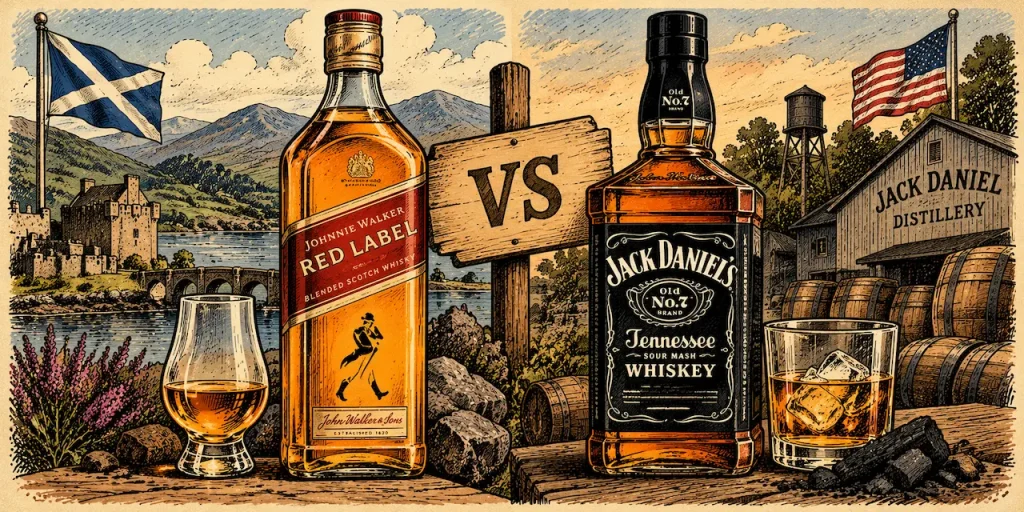
Walk into just about any bar on the planet, from a five-star hotel in London to some questionable establishment in the middle of nowhere, and you’ll probably find two familiar faces behind the counter: Johnnie Walker and Jack Daniel’s.
One is Scottish, the other American. One has a reputation for smoke, dried fruit and respectable evenings. The other tastes of caramel, vanilla and the sort of decisions you make after midnight.
Both sell whisky by the truckload. Johnnie Walker is the world’s biggest Scotch brand, while Jack Daniel’s sits at the top of the American whiskey business. Together, they’ve conquered bars, airport duty-free shops and liquor cabinets in just about every country where drinking is legal.
But here’s the funny thing. They have almost nothing in common beyond being made from grain, spending time in wooden barrels and occasionally giving people terrible hangovers.
Different ingredients, different production methods, different traditions. Hell, they can’t even agree on how to spell whisky.
So what’s the actual difference between Johnnie Walker and Jack Daniel’s, and which one deserves a place on your shelf?
Two countries, two completely different rulebooks
The Scots have rather strong opinions about whisky. They’ve even written them into law, which is probably the most Scottish thing imaginable.
For something to qualify as Scotch whisky, it must be produced in Scotland, follow specific distillation rules and spend at least three years maturing in oak casks. There are restrictions on ingredients, alcohol strength and what producers can put into the finished bottle.
Johnnie Walker is a blended Scotch, meaning it combines malt and grain whiskies from different Scottish distilleries. Some bring smoke, others fruit, honey or cereal sweetness. The blender’s job is to get them all working together without turning the result into an expensive mess.
It’s a bit like assembling a football team. Having eleven excellent players doesn’t guarantee they’ll play well together.
Jack Daniel’s operates under a different set of rules.
Produced in Lynchburg, Tennessee, it’s classified as Tennessee whiskey. The standard Old No. 7 recipe uses 80% corn, 12% rye and 8% malted barley, and the whiskey matures in new charred oak barrels.
Those specifications also satisfy the basic production requirements for bourbon, although Jack Daniel’s has spent decades insisting on its own Tennessee identity.
The main distinction is the Lincoln County Process.
Before entering the barrel, Jack Daniel’s whiskey passes slowly through roughly ten feet of sugar maple charcoal. The process removes certain compounds from the spirit and contributes to its familiar character.
Tennessee law generally requires this charcoal mellowing for whiskey carrying the state’s name, with a specific exemption for Benjamin Prichard’s distillery.
Johnnie Walker, meanwhile, has no equivalent requirement. Its character comes from blending whiskies produced across Scotland.
One brand relies on combining different distillery styles. The other builds its identity around a particular recipe and production process.
Neither approach is inherently superior. Anyone claiming otherwise probably has a favourite brand tattooed somewhere unfortunate.
Barley vs corn: where the flavour begins
Before the barrels, the charcoal and the marketing departments get involved, whisky starts with grain. And the choice of grain matters quite a lot.
Johnnie Walker: barley, grain and a little Scottish smoke
Johnnie Walker uses a combination of malt whisky and grain whisky.
The malt component comes from malted barley, traditionally distilled in copper pot stills. Depending on where it’s produced, it can deliver flavours ranging from honey and biscuits to dried fruit, spice and peat smoke.
That last one is particularly important.
Johnnie Walker Black Label has a recognisable smoky character, partly thanks to peated malt whiskies in the blend. It’s not particularly aggressive, but there’s enough smoke to remind you that Scotland has been setting fire to peat for a very long time.
The grain whisky brings a lighter, generally sweeter foundation. Together, they create something more layered than either component would necessarily manage alone.
Jack Daniel’s: corn, sweetness and that bloody banana
Jack Daniel’s takes a different route, with corn making up 80% of its mash bill.
Corn contributes to the whiskey’s sweet, rounded character. Rye brings some spice, while malted barley supplies enzymes needed to convert starch into fermentable sugars.
But there’s another flavour that tends to stand out in Old No. 7.
Banana.
Yes, banana. Once somebody points it out, it’s rather difficult to ignore.
That fruity note comes largely from esters produced during fermentation, including isoamyl acetate. Combine those with the vanilla and caramel flavours picked up during maturation, and you have the familiar Jack Daniel’s profile.
Johnnie Walker leans towards malt, fruit and smoke. Jack Daniel’s leans towards sweetness, vanilla and toasted oak.
It’s a fundamental difference, not something invented by a marketing department to justify another limited-edition bottle.
Distillation: copper pots against industrial columns
Here’s where whisky production starts sounding like something from an engineering manual.
Traditional Scotch malt whisky is distilled in copper pot stills, usually twice, although some distilleries use different arrangements.
These large copper vessels operate in batches. Their shape, size and operating conditions influence which compounds make it into the final spirit.
A tall still generally encourages more reflux and can produce a lighter spirit. Shorter stills often produce something heavier, although the full picture is considerably more complicated.
Grain whisky, on the other hand, is generally produced using continuous column stills. Johnnie Walker combines both styles, giving its blenders a large selection of different whiskies to work with.
Jack Daniel’s uses column distillation for its whiskey before sending the spirit through charcoal mellowing. That charcoal treatment helps remove certain heavier or harsher compounds before maturation.
The result is a spirit designed to develop into Jack Daniel’s recognisable sweet, mellow style. Of course, smoother doesn’t automatically mean better.
Some of the most interesting whiskies in the world have a bit of bite to them. Personally, I’d rather have something with character than a spirit so thoroughly polished that it tastes of absolutely nothing.
The barrel: where things get interesting
If you’ve ever wondered why Jack Daniel’s tastes strongly of vanilla and caramel while Johnnie Walker often brings more fruit and smoke, the barrels deserve a good share of the credit. Jack Daniel’s Old No. 7 matures in brand-new American white oak barrels, charred on the inside.
That fresh oak is packed with compounds that contribute vanilla, caramel, toasted sugar and woody flavours as the whiskey matures.
Tennessee’s warm summers and seasonal temperature changes encourage the spirit to move in and out of the wood. And unlike Scotch, which often spends years in previously used barrels, Jack Daniel’s gets a fresh one every time.
Johnnie Walker works with a broader collection of casks.
Many Scotch whiskies mature in barrels that previously held American whiskey, including bourbon. Others spend time in sherry-seasoned casks or refill barrels that have already been used for Scotch.
Each brings something different.
An ex-bourbon barrel might contribute vanilla, coconut and gentle oak sweetness. Sherry-seasoned wood can bring dried fruit, spice and richer flavours. A refill cask generally allows more of the underlying spirit character to remain prominent.
There’s a certain irony here.
The American whiskey industry needs new charred barrels for its bourbon-style production. Once those barrels have served their purpose, many eventually find their way across the Atlantic to Scotland.
So while whisky drinkers argue about whether Scotch or American whiskey is superior, the two industries are quite happily doing business with each other.
If you’re curious about how much difference wood can make, our guide to whisky cask types goes deeper into the subject.
Age statements: does older actually mean better?
Johnnie Walker makes considerable use of age statements. Black Label is twelve years old. There’s also an 18 Year Old expression, alongside bottles such as Red Label, Double Black, Gold Label Reserve and Blue Label that carry no age statement.
Under Scotch whisky rules, the age printed on a bottle refers to the youngest whisky in the blend.
So if Black Label contains whiskies aged twelve, fifteen and twenty years, the bottle still says twelve.
Jack Daniel’s Old No. 7 doesn’t carry an age statement.
Its distillers judge maturation by the character of the whiskey rather than promising a particular number of years in the barrel.
Does that mean Johnnie Walker Black Label is automatically better because it’s older?
Of course not.
Scotland and Tennessee have different climates, and maturation doesn’t happen at an identical pace in both places.
The wood, warehouse conditions, spirit and climate all influence the result.
I’ve never understood the obsession with treating whisky age like some kind of scoreboard. A twenty-year-old bottle can be magnificent, but it can also be a spectacularly expensive disappointment.
And a younger whiskey can be perfectly enjoyable.
Age tells you how long the spirit has been sitting in a barrel. It doesn’t guarantee that somebody made good decisions along the way.
Johnnie Walker vs Jack Daniel’s: what do they actually taste like?
Enough about production. Most people aren’t buying a bottle because they’re fascinated by column stills.
They want to know what the bloody stuff tastes like. For this comparison, we’re looking at Johnnie Walker Black Label and Jack Daniel’s Old No. 7, two of the most recognisable bottles from their respective brands.
Johnnie Walker Black Label
Black Label is a fairly approachable introduction to blended Scotch.
Its typical flavour profile starts with dried fruit, vanilla and a little honeyed sweetness. There’s some spice in the background, followed by that familiar touch of peat smoke.
The smoke isn’t particularly heavy.
You won’t feel like somebody has emptied an ashtray into your glass, which is something I appreciate. Heavily peated whisky has its audience, but not everybody wants to spend an evening drinking what smells like a burning fishing boat.
Black Label has enough going on to remain interesting without demanding your complete attention.
It’s the sort of whisky that makes sense neat, with a little water or in a simple highball.
Jack Daniel’s Old No. 7
Jack Daniel’s is considerably sweeter in character.
Caramel, vanilla and banana are the flavours most commonly associated with Old No. 7, followed by toasted oak and a little spice.
There’s some charcoal influence, although not the sort of peat smoke you’d associate with Scotch.
The finish is relatively short and sweet, without the same layers of fruit and smoke found in Black Label.
That doesn’t make it a bad whiskey.
It makes it a different whiskey.
Old No. 7 is easy to recognise, easy to mix and familiar to millions of people who couldn’t care less about the difference between a pot still and a column still.
And frankly, there’s something to be said for that.
Both are commonly bottled at 40% ABV in international markets, although bottling strengths can vary. The difference in flavour isn’t simply a matter of one being stronger than the other.
Which is better neat, and which belongs in a cocktail?
Here’s where I’ll happily take sides. If I’m choosing between Johnnie Walker Black Label and Jack Daniel’s Old No. 7 for drinking neat, I’m taking the Black Label.
There’s more going on. The combination of fruit, malt sweetness and smoke gives it enough character to enjoy without adding anything.
Jack Daniel’s isn’t undrinkable neat. Far from it. But Old No. 7 doesn’t offer quite the same complexity. Now, throw a bottle of Coca-Cola into the equation and things change.
Jack Daniel’s and Coke is one of the great combinations in the drinking world. Not sophisticated, not particularly fashionable among whisky enthusiasts, but undeniably effective.
The whiskey’s vanilla and caramel flavours work naturally with cola, and the combination has been keeping bartenders busy for generations. Johnnie Walker Red Label is also made with mixing in mind, particularly highballs.
But if you’re paying extra for Black Label, I wouldn’t personally drown it in Coke. You’re covering up much of what makes the whisky interesting in the first place.
Still, it’s your bottle. If you want to mix a ridiculously expensive Scotch with supermarket cola, go ahead. Just don’t expect me to understand the financial reasoning.
Why Johnnie Walker and Jack Daniel’s are both enormous
There’s a temptation among whisky enthusiasts to dismiss mass-market brands.
Apparently, once something becomes popular enough, it stops being interesting. I don’t buy that argument.
Johnnie Walker and Jack Daniel’s have become global giants because they offer consistency, recognisable flavours and bottles that people know what to do with.
Johnnie Walker built its reputation around blending Scotch whisky into a dependable house style. The company can draw on different distilleries and casks while keeping its core expressions recognisable.
Jack Daniel’s has done something similar through a single distillery, a consistent mash bill, charcoal mellowing and barrel selection.
The approaches are different, but the commercial objective is much the same. Make something people recognise, enjoy and buy again. There’s nothing particularly romantic about that, but it’s an impressive achievement.
And neither brand is standing still.
Johnnie Walker offers everything from the straightforward Red Label to the considerably more expensive Blue Label. Jack Daniel’s has expanded into Single Barrel, Gentleman Jack, rye whiskey and bonded expressions.
The bottles sitting behind the average bar are only the beginning.
So, which one should you buy?
If you’re looking for a whisky to drink neat and want to explore the smoky, fruity character of Scotch, Johnnie Walker Black Label is my pick between these two.
If you’re after something sweeter, particularly for mixing with Coke, Jack Daniel’s Old No. 7 makes more sense.
That’s not a universal verdict on which brand is better. Compare Jack Daniel’s Single Barrel Barrel Proof with Johnnie Walker Red Label and you’re having an entirely different conversation.
And that’s the point.
Neither brand can be judged by one bottle, and neither represents everything its country has to offer.
If Black Label appeals to you, try exploring single malt Scotch next. Distilleries such as Caol Ila and Cardhu have longstanding associations with Johnnie Walker blends and offer different directions to explore.
If you prefer Jack Daniel’s, look into Tennessee whiskey and bourbon. There’s an enormous world of American whiskey beyond Old No. 7.
Our whisky for beginners guide is a useful starting point if you’re still figuring out what you like, and the whisky reviews section will grow as we cover more bottles.
Ultimately, Johnnie Walker and Jack Daniel’s have both earned their places behind the bar.
One built an empire by blending whiskies from across Scotland. The other built one around a distillery in a small Tennessee town.
Both have been remarkably successful at persuading the world to drink their products.
And while whisky enthusiasts can spend hours arguing about which one deserves more respect, most people are simply going to order whichever they prefer.
Which, when you think about it, is probably the most sensible approach to drinking whisky in the first place.