Walk into an American bar, order a whiskey and Coke, and there’s a decent chance you’ll end up with either Jim Beam or Jack Daniel’s.
Both are American. Both come from places where whiskey is practically part of the local economy. Both have spent decades turning corn, oak and clever marketing into enormous international businesses.
And both are perfectly capable of making your Saturday night considerably more interesting than your Sunday morning.
But ask a whiskey enthusiast whether Jim Beam and Jack Daniel’s are basically the same thing, and you’ll probably get a lecture long enough to make you regret ordering anything.
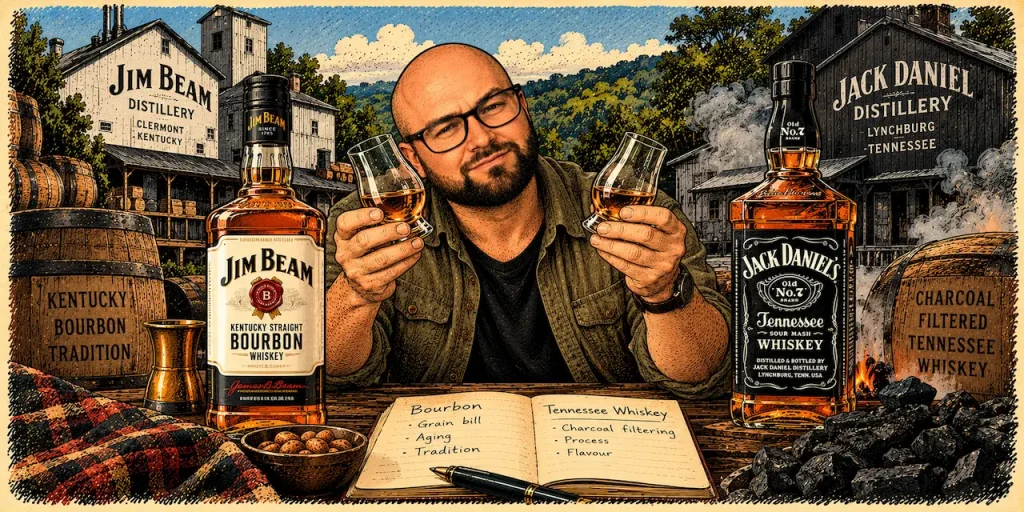
One is bourbon. The other is Tennessee whiskey. One comes from Kentucky, the other from Tennessee. One makes a great deal of noise about charcoal mellowing, while the other is perfectly happy to let the whiskey go straight into the barrel.
Does any of this actually matter?
Yes, although perhaps not as much as the marketing departments would like you to believe.
I’ve always found the rivalry interesting because these are two brands that occupy almost identical territory in the average liquor shop. Neither is particularly expensive, neither is especially fashionable among whiskey snobs, and both are more commonly associated with mixed drinks than serious tasting sessions.
Yet behind those familiar labels are two quite different approaches to making American whiskey.
And once you move beyond the cheapest bottles, things get considerably more interesting.
Jim Beam vs Jack Daniel’s: the differences at a glance
| Jim Beam White Label | Jack Daniel’s Old No. 7 | |
|---|---|---|
| Whiskey type | Kentucky straight bourbon | Tennessee whiskey |
| Origin | Kentucky | Tennessee |
| Distillery | Clermont and Boston, Kentucky | Lynchburg, Tennessee |
| Main grain | Corn | Corn |
| Mash bill | Commonly reported as 77% corn, 13% rye, 10% malted barley | 80% corn, 12% rye, 8% malted barley |
| Charcoal mellowing | No Lincoln County Process | Yes |
| Barrels | New charred American oak | New charred American oak |
| Age statement | 4 years | None |
| Typical flavours | Vanilla, corn, oak, nuts, spice | Caramel, banana, vanilla, toasted oak |
| Common bottling strength | 40% ABV | 40% ABV |
| Parent company | Suntory Global Spirits | Brown-Forman |
On paper, they’re remarkably similar.
Both use corn-heavy recipes, sour mash fermentation and new charred oak barrels. Both produce whiskey at an enormous scale, and both have spent generations trying to make every bottle taste reassuringly familiar.
The main difference is what happens between distillation and maturation.
But first, a little geography.
Kentucky vs Tennessee: two states that take whiskey personally
Jim Beam comes from Kentucky, the spiritual home of bourbon.
The Beam family’s whiskey-making history stretches back to 1795, when Jacob Beam began selling whiskey in the region.
The business survived generations of changing tastes, political interference and Prohibition, eventually becoming one of the defining names in American bourbon.
Today, Jim Beam is owned by Suntory Global Spirits, part of Japan’s Suntory group.
Yes, one of America’s most famous bourbon brands belongs to a Japanese company.
That tends to upset a certain type of American whiskey traditionalist, although I suspect most customers are more concerned with the price of the bottle than the nationality of its shareholders.
The Beam family remains closely associated with the distillery. Fred Noe represents the seventh generation of Beam distillers, while his son Freddie has taken on an increasingly prominent role in whiskey-making.
Jack Daniel’s comes from Lynchburg, Tennessee, a small town with an extraordinary claim to fame.
It’s home to one of the world’s most recognisable whiskey brands, despite being located in Moore County, where local alcohol restrictions make buying a drink considerably more complicated than you’d expect.
There’s something wonderfully American about building a global whiskey empire in a place where you can’t simply walk into a bar and order one.
Jack Daniel’s traces its official founding to 1866, although the precise historical date is disputed.
Since 1956, the brand has belonged to Brown-Forman.
And here’s another amusing detail: Brown-Forman is headquartered in Louisville, Kentucky.
So the great Tennessee whiskey brand is owned by a company based in bourbon country.
The rivalry looks rather less dramatic once you start following the money.
Bourbon vs Tennessee whiskey: what the hell is the difference?
This is where people usually start arguing.
Jim Beam is bourbon.
Jack Daniel’s is Tennessee whiskey.
Simple enough, until somebody announces that Jack Daniel’s is technically bourbon, somebody else insists it absolutely isn’t, and the entire evening disappears into a debate about federal regulations.
Here’s what matters.
Bourbon must be made in the United States from a mash containing at least 51% corn. It must be distilled below a specified maximum strength, entered into new charred oak containers at no more than 125 proof, and bottled at a minimum of 40% alcohol.
Jim Beam follows those rules.
Jack Daniel’s also meets the core production requirements for bourbon.
But the company has long chosen to identify its whiskey as Tennessee whiskey, emphasising a distinctive production method known as the Lincoln County Process.
That additional step involves passing the spirit through sugar maple charcoal before maturation.
Tennessee law generally requires the process for whiskey labelled Tennessee whiskey, with a specific exemption for Benjamin Prichard’s distillery.
So Jack Daniel’s isn’t some mysterious category of spirit completely unrelated to bourbon.
It’s a close relative produced according to a particular Tennessee tradition.
Does that make it better?
Not necessarily.
Does it make it different?
Absolutely.
And if you’re drinking the stuff rather than arguing over definitions, that’s the more interesting question.
The grain: almost identical recipes
You might expect the two whiskeys to taste different because they’re made from different ingredients.
Not really.
Both start with corn-heavy mash bills.
Jim Beam’s standard recipe is commonly reported as approximately 77% corn, 13% rye and 10% malted barley.
Jack Daniel’s uses 80% corn, 12% rye and 8% malted barley.
That’s hardly an enormous difference.
Corn provides much of the sweet foundation associated with bourbon and Tennessee whiskey. Rye contributes spice, while malted barley supplies enzymes that help convert grain starches into fermentable sugars.
But grain percentages alone don’t determine the finished flavour.
Yeast, fermentation, distillation, maturation and barrel selection all influence what ends up in the glass.
And that’s why two whiskeys made from remarkably similar recipes can taste quite different.
Sour mash: the process that sounds worse than it is
Jack Daniel’s makes a point of putting Sour Mash on its label.
To somebody unfamiliar with American whiskey, that might sound like a warning.
It isn’t.
Sour mash is a common production method in which some spent material from a previous distillation is added to the next mash.
This helps manage acidity and supports consistent fermentation conditions.
It’s widely used throughout the American whiskey industry, including at Jim Beam.
So despite the prominent lettering on the Jack Daniel’s bottle, sour mash isn’t something that makes Old No. 7 uniquely special.
It’s a normal part of how many American whiskeys are produced.
And that’s fine.
Not every traditional production method needs to be presented as though somebody discovered it in a secret cave beneath Tennessee.
Yeast: the little organism doing the dirty work
Whiskey marketing loves barrels, distilleries and stories about the men who founded them.
Yeast rarely gets the same attention.
Which is rather unfair, considering that without it we’d be drinking grain-flavoured water.
During fermentation, yeast converts sugars into alcohol while producing numerous compounds that influence aroma and flavour.
Different yeast strains and fermentation conditions can create noticeably different results.
Jim Beam maintains a proprietary yeast strain associated with the family’s post-Prohibition revival.
According to the company’s history, Jim Beam himself was particularly protective of the yeast, keeping a portion safe to prevent the strain from being lost.
Jack Daniel’s also maintains its own yeast culture.
These differences help explain why the two brands develop distinct fruity characteristics.
Jack Daniel’s is particularly associated with banana-like aromas, linked to esters such as isoamyl acetate.
Jim Beam tends towards a different combination of grain, fruit and nutty characteristics.
It’s a reminder that whiskey flavour begins long before the spirit reaches the barrel.
The Lincoln County Process: Jack Daniel’s biggest selling point
Now we reach the part that genuinely separates the two.
After distillation, Jack Daniel’s whiskey passes slowly through roughly ten feet of sugar maple charcoal.
The charcoal is produced from maple wood burned by the distillery, and the mellowing process takes several days.
The idea is to remove certain compounds from the newly distilled spirit before it enters the barrel.
Charcoal can adsorb some heavier or less desirable compounds, changing the spirit’s chemical composition and sensory character.
Jack Daniel’s calls this charcoal mellowing.
The broader industry knows it as the Lincoln County Process.
And it’s central to the brand’s identity.
Jim Beam doesn’t use this pre-barrel charcoal mellowing step.
Its whiskey proceeds through the standard bourbon production process before entering new charred oak barrels.
Does that mean Jim Beam is rougher?
It can have a more pronounced grain and spice character, while Jack Daniel’s is generally associated with a softer, sweeter profile.
But it’s important not to pretend charcoal mellowing explains every difference between them.
Fermentation, distillation, maturation and blending decisions also matter.
And smoother doesn’t automatically mean better.
I’ve never been particularly interested in whiskey that’s been polished until there’s nothing left to taste.
A little edge can be a good thing.
On the other hand, there’s nothing wrong with enjoying a softer whiskey either.
The question is whether you prefer what’s left in the glass.
The barrels: where both brands get serious
Jim Beam and Jack Daniel’s both mature their whiskey in new charred American oak barrels.
This is one of the defining features of bourbon-style American whiskey production.
Freshly charred oak contributes compounds associated with vanilla, caramel, toasted sugar, spice and wood.
The charred interior also influences how the spirit interacts with the barrel.
And in Kentucky and Tennessee, the climate plays a significant role.
Hot summers and seasonal temperature changes affect the interaction between whiskey and wood, while warehouse conditions can produce noticeable differences between barrels.
A barrel stored near the top of a warehouse may experience different temperatures from one stored closer to the ground.
Over several years, those differences can become significant.
Both producers use barrel selection and blending to maintain their familiar house styles.
Brown-Forman also owns cooperage operations, giving Jack Daniel’s considerable control over the barrels used in its production.
Jim Beam works with established barrel suppliers, including Independent Stave Company.
Different arrangements, similar objectives.
Make enormous quantities of whiskey while ensuring the customer gets something recognisable every time.
It’s a less romantic achievement than discovering a forgotten barrel in a dusty warehouse, but an impressive one nonetheless.
Jim Beam’s two distilleries against Jack Daniel’s one
There’s another interesting difference between the brands.
Jim Beam has historically operated major production facilities at Clermont and Boston, Kentucky.
The company has also developed the Fred B. Noe Distillery at Clermont for smaller-scale and experimental whiskey production.
Jack Daniel’s has concentrated its production in Lynchburg, expanding the site and surrounding barrel-storage infrastructure as demand has grown.
That gives the two companies different operational structures.
Jim Beam can distribute production across facilities.
Jack Daniel’s has built an enormous operation around one geographic location.
From a marketing perspective, the Lynchburg story is extremely useful.
Every bottle comes with a connection to the same small Tennessee town.
But maintaining that commitment at global scale requires serious infrastructure.
It isn’t simply a charming tradition.
It’s an expensive logistical decision.
Four years vs no age statement
Jim Beam White Label has a straightforward selling point.
It’s aged for four years.
That matters because straight bourbon must mature for at least two years, and bourbon aged less than four years must disclose its age.
Jim Beam White Label goes beyond the minimum and tells you exactly how long it has matured.
Jack Daniel’s Old No. 7 carries no age statement.
The company selects barrels according to the flavour and maturity profile it wants rather than advertising a fixed minimum number of years beyond applicable legal requirements.
That doesn’t automatically make Jim Beam better.
Age statements tell you how long whiskey has matured. They don’t guarantee quality.
A younger whiskey from an active barrel can develop considerable oak character, while an older one might become excessively woody or bitter.
I’ve never understood the obsession with treating age statements like a scoreboard.
If the whiskey tastes good, the number matters considerably less.
And if it tastes terrible, leaving it in a barrel for another decade isn’t necessarily going to rescue it.
Jim Beam vs Jack Daniel’s: what do they actually taste like?
Enough history and production methods.
Let’s get to the important bit.
Jim Beam White Label
Jim Beam White Label is straightforward Kentucky bourbon.
Its typical flavour profile includes corn sweetness, vanilla, oak and a distinctive nutty character.
There’s some rye spice, a little graininess and a relatively short finish.
It can feel slightly sharper than Jack Daniel’s Old No. 7, particularly when drinking it neat.
That isn’t necessarily a criticism.
Jim Beam has a recognisable bourbon character, even if the standard expression doesn’t offer enormous complexity.
It’s inexpensive, familiar and perfectly capable of doing its job.
Jack Daniel’s Old No. 7
Jack Daniel’s is sweeter and softer in character.
Caramel, vanilla, banana and toasted oak dominate the familiar flavour profile.
The banana note is particularly distinctive, and once somebody points it out, it’s difficult to ignore.
The finish is relatively short, with less obvious spice than Jim Beam.
Old No. 7 isn’t especially complex.
But it has a clear identity.
And that identity works extremely well in mixed drinks.
The comparison
| Characteristic | Jim Beam White Label | Jack Daniel’s Old No. 7 |
|---|---|---|
| Sweetness | Moderate to pronounced | Pronounced |
| Vanilla | Noticeable | Prominent |
| Fruit | Light fruit notes | Distinctive banana |
| Spice | More noticeable rye spice | Gentler spice |
| Oak | Dry, toasted oak | Sweeter, charred oak |
| Finish | Short, slightly spicy | Short, sweet |
| Overall style | Traditional, straightforward bourbon | Soft, sweet Tennessee whiskey |
Neither is particularly sophisticated at this level.
And I don’t think either needs to be.
These are mass-market whiskeys built for everyday drinking, not rare collector’s bottles that require a second mortgage.
Which is better for drinking neat?
Between Jim Beam White Label and Jack Daniel’s Old No. 7, I’d lean towards Jim Beam if I wanted something with a more traditional bourbon character.
The grain, nutty notes and spice give it a little more edge.
But I wouldn’t pretend either is my first choice for a long evening of sipping whiskey.
Both companies make more interesting bottles.
And that’s where I’d spend the extra money.
If you’re determined to drink the standard expressions neat, try both and decide whether you prefer Beam’s slightly sharper profile or Jack Daniel’s sweeter approach.
There’s no great mystery here.
Personal preference matters more than the state printed on the label.
Which is better with Coke?
Jack Daniel’s.
There, that was easy.
Old No. 7’s caramel, vanilla and banana characteristics work naturally with cola.
There’s a reason Jack and Coke became one of the world’s most recognisable whiskey drinks.
The combination makes sense.
Jim Beam works perfectly well with cola too, but its slightly spicier character creates a different result.
And before the whiskey purists start complaining, there’s absolutely nothing wrong with mixing either of them.
If you want a whiskey and Coke, have one.
You don’t need permission from somebody who owns a collection of expensive tasting glasses.
Where things get interesting: Knob Creek vs Jack Daniel’s Single Barrel
The problem with comparing only Jim Beam White Label and Jack Daniel’s Old No. 7 is that you’re judging two enormous whiskey producers by their most familiar entry-level products.
It’s a bit like comparing two car manufacturers exclusively by their cheapest models.
You learn something, certainly.
But not everything.
Jim Beam’s wider portfolio includes Knob Creek, Booker’s, Baker’s and Basil Hayden, alongside expressions such as Jim Beam Black and Double Oak.
Knob Creek is particularly worth exploring.
It offers a fuller bourbon experience, with more pronounced oak, spice and richness than standard Jim Beam.
Booker’s takes things further with uncut, unfiltered bourbon bottled at substantial strength.
Jack Daniel’s has its own premium expressions.
Single Barrel Select offers individual barrel character rather than the carefully blended consistency of Old No. 7.
Single Barrel Barrel Proof takes that approach further, delivering a much more intense whiskey at barrel strength.
There are also bonded expressions and older age-stated releases that demonstrate how much more the Lynchburg distillery can produce.
These are the bottles that make the argument interesting.
If somebody tells you Jack Daniel’s is rubbish because they once drank too much Old No. 7 at a student party, I’d suggest they try one of the Single Barrel expressions before writing off the entire distillery.
The same applies to Jim Beam.
White Label isn’t the limit of what the company can do.
Not even close.
Which offers better value?
That depends heavily on where you’re buying.
In some countries, Jim Beam White Label is noticeably cheaper than Jack Daniel’s Old No. 7.
In others, the difference is relatively small.
And import duties, local taxes and distribution arrangements can completely change the comparison.
If Jim Beam costs considerably less, it’s difficult to argue against it as an everyday bourbon for mixing.
If the bottles cost roughly the same, personal preference becomes more important.
But here’s where I’d make a different suggestion.
Before paying a premium for either familiar label, check what else is available.
Wild Turkey 101, Buffalo Trace and Evan Williams Bottled-in-Bond are all worth considering, depending on local pricing.
They offer different combinations of strength, flavour and value.
You might prefer them.
You might not.
But at least you’ll be making a decision based on what’s inside the bottle rather than which brand has the better advertising campaign.
The verdict: Jim Beam or Jack Daniel’s?
For me, Jim Beam White Label has the edge if you want a straightforward bourbon with a little grain character and spice.
Jack Daniel’s Old No. 7 is the better choice if you prefer a sweeter, softer whiskey, particularly for mixing with cola.
Neither is a particularly exciting sipping whiskey in its standard form.
And neither represents the best its producer can make.
That’s the important distinction.
Jim Beam has an enormous bourbon portfolio, including some genuinely excellent higher-end expressions.
Jack Daniel’s has demonstrated through its Single Barrel and barrel-proof releases that Lynchburg is capable of producing whiskey with considerably more character than Old No. 7 might suggest.
The two companies have different traditions, different production methods and different flavour profiles.
But they’re also remarkably similar in one respect.
Both have spent generations producing dependable American whiskey for people who simply want a drink.
There’s nothing wrong with that.
Not every bottle needs to be a rare single cask discovered by a master distiller with a beard and an elaborate family story.
Sometimes you want a decent whiskey at a reasonable price.
And sometimes you want something more interesting.
The trick is knowing which one you’re paying for.
My choice? Jim Beam for an inexpensive everyday bourbon, Jack Daniel’s for a whiskey and Coke. But if I’m buying something to sit down and properly enjoy, I’m moving further up either company’s range.
Because the best argument for both distilleries isn’t what they put in their cheapest bottles.
It’s what they’re capable of making when they stop worrying quite so much about keeping everybody happy.