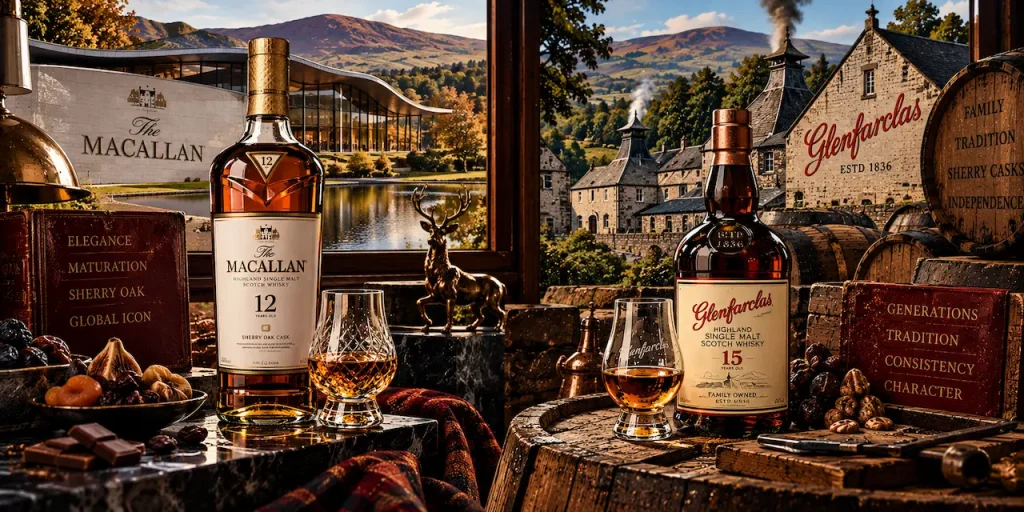
For much of the twentieth century, if you wanted a sherried Speyside malt, you chose between two names: Macallan and Glenfarclas. Both sit a few miles apart in the heart of the region. Both built their reputations on Spanish oak seasoned with oloroso sherry. Both were, for a long time, bottled at similar ages and sold at similar prices to a similar crowd.
They have since gone in opposite directions. Macallan is now a luxury brand whose old bottles set auction records, with a distillery that looks like a hillside from a science-fiction film. Glenfarclas is still run by the Grant family from the same site they bought in 1865, and its 25 Year Old costs less than Macallan’s 18. The whiskies have diverged along with the businesses, and understanding why tells you a great deal about modern Scotch.
Ownership: the root of everything
Glenfarclas has had one owner since 1865: J. & G. Grant. It is now in the sixth generation. The family has never sold shares, never taken outside investment, and has a stated policy of never being “the biggest, just the best”. That independence lets them do things a corporate owner would not — most famously holding back enormous stocks of old whisky through the lean years of the 1980s when competitors were selling off or shutting down.
Macallan has been owned since 1999 by the Edrington Group, a company controlled by a charitable trust, which also owns Highland Park and The Famous Grouse. Edrington made a deliberate decision in the 2000s to reposition Macallan as a luxury brand, with pricing, packaging and distribution to match. The new distillery, opened in 2018 at a reported cost of around £140 million, is the physical expression of that strategy.
Neither approach is wrong. But they produce very different whiskies, and very different prices.
Both distillery pages — Macallan and Glenfarclas — have the full histories.
Sherry casks: the same idea, done differently
Both houses are famous for sherry wood, but the detail matters.
Macallan’s claim is that it spends more on wood than any other distillery, and it is probably true. The company commissions casks from Spanish cooperages, has them made from both European and American oak, seasons them with sherry for around eighteen months to two years in Jerez, then ships them to Scotland. Since the mid-2000s Macallan has also used ex-bourbon casks in part of its range; the Double Cask series blends American-oak sherry casks with European-oak ones, and the Triple Cask (formerly Fine Oak) adds bourbon wood. The pure European-oak sherry style survives mainly in the Sherry Oak line.
Glenfarclas uses oloroso-seasoned casks, predominantly European oak, and largely refill rather than first-fill. The distillery buys from one bodega, Jose y Miguel Martin, and has done for decades. The proportion of first-fill casks is lower than Macallan’s, which means the sherry influence is slower and less intense, and the spirit shows through more. Glenfarclas also matures entirely in traditional dunnage warehouses — low, earth-floored, stone-walled — which run cooler and damper than modern racked warehouses.
Our guides to cask types and wood and flavour cover why first-fill versus refill, and European versus American oak, change the whisky so dramatically.
The spirit underneath
This is the part the marketing skips.
Macallan’s stills are famously small and squat — the distillery calls them “curiously small” — which produces a rich, oily, heavy new-make. That weight is what lets the spirit stand up to heavy sherry wood for decades. The new distillery has thirty-six of them.
Glenfarclas runs six very large stills, among the biggest in Speyside, and heats them with direct gas flame rather than internal steam coils — one of only a handful of distilleries still doing so. Direct firing creates hot spots that caramelise sugars in the wash, adding a toasty, slightly burnt note that Glenfarclas considers part of its character. The spirit is robust and a little rougher than Macallan’s, with a sulphury, meaty edge when young that softens beautifully with age.
So: Macallan is weighty and smooth; Glenfarclas is weighty and rugged. Both need time in good oak, and both get it.
Age statements and where the money goes
Here the two part company most visibly.
Glenfarclas’s core range runs 10, 12, 15, 17, 21, 25, 30 and 40 Year Old, all with age statements, all at relatively steady prices. The 15 at 46 per cent is often cited as the best-value sherried malt in Scotland. The 25 sells for roughly what Macallan charges for its 15. The “Family Casks” series offers single casks from nearly every year since the 1950s.
Macallan’s core range has shifted toward no-age-statement expressions — the Gold, Amber, Sienna and Ruby “1824 Series” of the 2010s, replaced by Double Cask 12, 15 and 18, plus the Sherry Oak and Triple Cask lines with ages, and a tier of NAS luxury releases (Rare Cask, Estate, the Harmony Collection). Age statements have returned as volumes allowed, but the brand is no longer organised around them. Our age statements guide explains what the shift to NAS whisky actually means for the drinker.
The auction market, and what it says
No comparison of these two is complete without the secondary market, because it has distorted the picture more than any other factor.
Macallan is the most valuable whisky brand at auction by a very wide margin. A bottle of Macallan 1926 Fine & Rare sold at Sotheby’s in London in 2023 for £2.1 million, the highest price ever paid for a bottle of whisky or indeed any spirit. The brand’s limited editions — the Lalique decanters, the Fine & Rare series, the Anniversary Malts, the Archival Series — routinely trade at multiples of their release prices, and in the 2010s Macallan accounted for something like a third of all value traded at UK whisky auctions. Edrington encourages this, within limits, because scarcity at the top reinforces the brand’s image all the way down to Double Cask 12.
Glenfarclas is nearly absent from that conversation, and the Grants seem to like it that way. The Family Casks series, launched in 2007, offered single-cask bottlings from most vintages back to the 1950s at prices that were, by Macallan standards, modest; many have since appreciated, but the family has never built the brand around flipping. Their position is that whisky is for drinking and that a 40 Year Old should cost what a 40 Year Old costs, not what a collector will pay.
The practical consequence is that a bottle of 25 Year Old Glenfarclas is a thing you can open on a birthday without feeling you have set fire to money, and the same age of Macallan is, for most people, a thing you keep. Which of those is the better use of a 25-year-old whisky is a philosophical question, but it is worth knowing which company you are buying into.
How they taste
Macallan 12 Sherry Oak: dried fruit, orange peel, chocolate, warm spice, a polished, creamy texture, a medium finish. Refined, cohesive, slightly sweet.
Glenfarclas 12: Christmas cake, nuts, a hint of struck match, more oak tannin, a drier finish. Less polished, more assertive.
At 15 and 18 the pattern holds. Macallan smooths; Glenfarclas deepens. At 25 and beyond, Glenfarclas becomes extraordinary — leathery, rancio, almost cognac-like — and remains affordable by the standards of old Scotch. Macallan’s old whiskies are, to be fair, often superb, but you are paying for the brand as well as the liquid.
Which one
If you value consistency, polish and a certain glamour, Macallan has earned its position. If you value the spirit, the age statement and the price on the shelf, Glenfarclas is one of the great bargains in whisky. Most enthusiasts drink the latter and collect the former, which is probably the right answer. Our tasting notes on both ranges are collected in the reviews as we publish them, and if you want to understand why Speyside became the home of sherried whisky, these two distilleries are the place to begin.