In 1900, if you ordered a whiskey in London, New York or Sydney and did not specify otherwise, you were likely to be served Irish. Dublin’s four great distilleries — John Jameson, William Jameson, John Power and George Roe — were the largest in the world, and Irish pot still whiskey was regarded as the finest. Scotch was the cheaper, cruder alternative. Seventy years later, the entire Irish industry consisted of two companies and a handful of distilleries, and its share of the world market had fallen to a rounding error. The reversal is one of the great business catastrophes of the twentieth century, and the recovery since the 1990s is one of its great comebacks. Both explain what is on the shelf today.
The height
The Irish industry of the 1880s was large, prosperous and conservative. There were around eighty-eight licensed distilleries across the island, with the biggest in Dublin, Cork and Belfast. The Dublin houses made single pot still whiskey — malted and unmalted barley, triple distilled in enormous copper pots — and sold it in cask to bonders and merchants who matured and bottled it. Roe’s distillery on Thomas Street covered seventeen acres and was the largest in Europe. The Ireland region page and the single pot still page cover the style and its home.
The industry’s confidence was its weakness. It believed its product was self-evidently superior and that the market would always agree.
The first mistake: the Coffey still
In 1830 an Irish excise officer named Aeneas Coffey patented a continuous column still that could produce light, clean spirit at high strength, cheaply and in volume. He offered it to the Dublin distillers. They turned it down, on the grounds that what it made was not whiskey. He took it to Scotland, where the grain distillers adopted it enthusiastically, and the Scottish blenders combined its output with malt whisky to make blends that were lighter, cheaper and more consistent than Irish pot still. Our pot still vs column still guide explains the technology.
The Dublin houses fought the blends rather than joining them. In 1878 four of them published Truths About Whisky, a pamphlet arguing that column-still spirit was a fraud and should not be allowed to bear the name. They lost. A Royal Commission in 1908–09 ruled that grain spirit from a patent still was whisky, and blended Scotch had the law on its side. By then it had the market too.
The second blow: war and independence
The First World War cut exports and raised duties. Then the Irish War of Independence and the partition of the island in 1921–22 severed the Dublin and Cork distillers from their biggest market, the British Empire. The new Irish Free State and Britain fell into a trade war in 1932 that lasted six years and effectively closed British and Commonwealth markets to Irish goods. Scotch, with no such problem, took the territory.
The third blow: Prohibition
The United States had been Irish whiskey’s other great market. The Volstead Act closed it from 1920 to 1933. Worse, the bootleggers who supplied the speakeasies sold vast quantities of counterfeit “Irish whiskey” — raw spirit with colouring — under names like Jameson and Powers, which did lasting damage to the reputation of the real thing. When repeal came, the Dublin distillers, cautious and short of capital, were slow to re-enter, and Scotch, which had already established American distribution through Canada, got there first.
The long decline
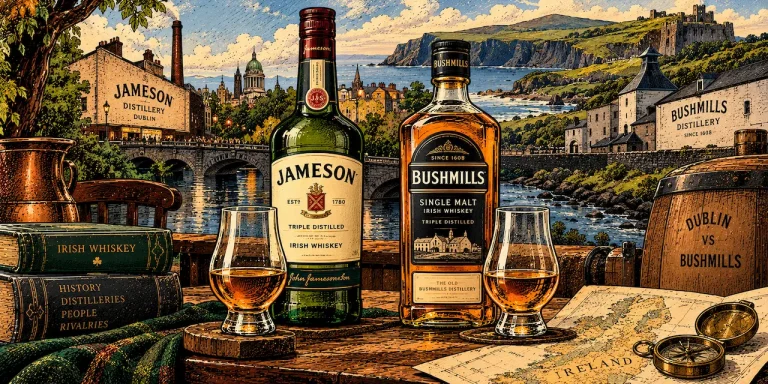
Through the 1930s, 40s and 50s the distilleries closed one by one. Roe shut in 1926, William Jameson in 1941. Belfast’s industry, once the largest in Ireland by volume, disappeared almost entirely. By the 1960s there were four significant producers left in the Republic — John Jameson, John Power, Cork Distilleries Company and Tullamore — and Bushmills in the north. In 1966 the first three merged, in a defensive consolidation, to form Irish Distillers. Tullamore sold its brand and closed. Bushmills joined the group in 1972. The entire Irish whiskey industry was, for a decade, one company.
Irish Distillers built a new distillery at Midleton in County Cork, opened in 1975, and closed the old Dublin sites: Bow Street, John’s Lane and the rest. Everything — Jameson, Powers, Paddy — was made under one roof. The Midleton page covers the plant that was, for fifteen years, Irish whiskey. The Bushmills page covers the one other site.
The turn
Three things reversed the decline.
The first was Pernod Ricard, which bought Irish Distillers in 1988 and decided to turn Jameson into a global brand. It had the money, the distribution and the patience, and over the next thirty years it took Jameson from under half a million cases a year to more than ten million, with the United States as its engine. Irish whiskey’s recovery is, by volume, Jameson’s recovery.
The second was Cooley. In 1987 John Teeling, a Dublin economist, bought a former industrial alcohol plant in County Louth and converted it into the first independent Irish whiskey distillery in a century. Cooley made single malt, grain and peated whiskey, revived the Kilbeggan and Tyrconnell names, and supplied a dozen new brands that gave the shelf variety it had not had since the 1920s. The Cooley page has its story; Beam bought it in 2011.
The third was the single pot still revival. Irish Distillers relaunched Redbreast in 1991 and built it, along with Green Spot, Powers John’s Lane and Midleton Very Rare, into a category that reminded the world what Irish whiskey had been before the blends.
The new wave
The 2010s brought the flood. The Teeling family, having sold Cooley, built a new distillery in Dublin in 2015 — the Teeling page tells it — and then the Great Northern Distillery to supply others. William Grant rebuilt Tullamore. Diageo entered with Roe & Co. Dozens of independents followed: Dingle, Waterford, Blackwater, Boann, Slane, Powerscourt, Killowen, Clonakilty, and more. By 2024 the island had more than forty working distilleries, from four in 2010. Sales passed fifteen million cases, growing faster than any other whisky category, with the United States taking roughly half. The Irish whiskey page maps the current landscape.
Belfast’s forgotten industry
One part of the story is often left out. In the late nineteenth century Belfast, not Dublin, was the largest whiskey-producing city in Ireland by volume. Dunville’s, Royal Irish, Avoniel and Connswater were vast distilleries, and Dunville’s VR was among the best-selling whiskeys in the world. Belfast’s distillers, unlike Dublin’s, embraced the column still and made blended whiskey for export, which should have positioned them to compete with Scotch. Partition, the trade war and Prohibition hit them as hard as anyone, and the city’s industry was gone by the 1940s; Dunville’s closed in 1936 despite being profitable, a decision its own board never adequately explained. The name was revived by the Echlinville distillery in County Down in 2013, which is a small part of the new wave’s broader project of recovering what was lost.
What the history explains
Three things on the shelf make sense only in light of this story. First, why Jameson dominates: it was the brand Pernod chose to carry the category, and the category followed. Second, why so many Irish brands are bottling someone else’s whiskey: the new distilleries’ own spirit is young, and Cooley, Great Northern and Bushmills supplied the gap. Third, why single pot still is both the oldest and the newest Irish style: it died with Dublin and was reborn at Midleton. Our tasting notes are collected in the reviews as we publish them, and the oldest bottles tell the saddest story, because they are nearly all that remains of distilleries that once ruled the world.