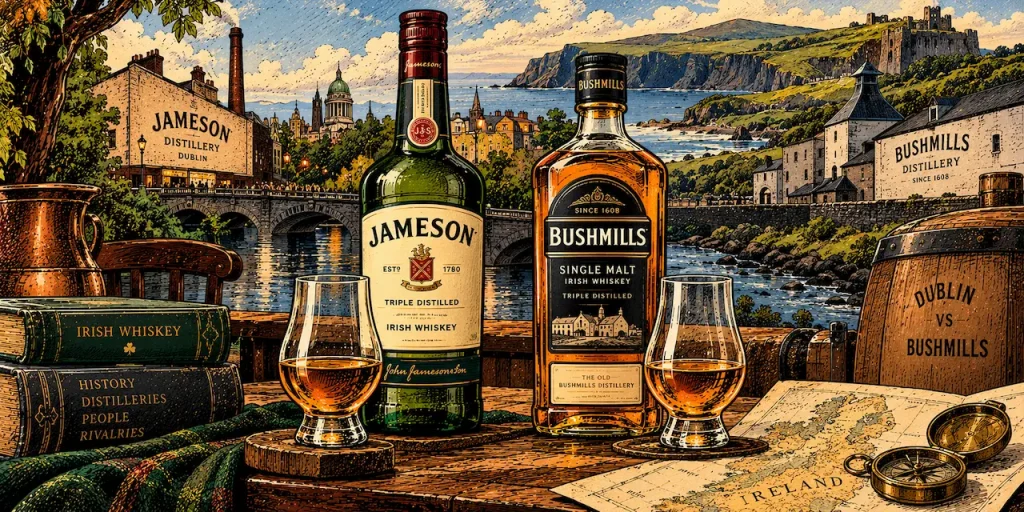
Walk into the right Irish pub, order a whiskey, and somebody might decide you’ve just made a political statement. Jameson, according to an old drinking-room legend, is Catholic whiskey. Bushmills is Protestant whiskey. One belongs to Dublin and the Republic, the other to Northern Ireland. Pick the wrong bottle in the wrong company and apparently you’ve declared allegiance to one side of a centuries-old argument.
It’s a wonderful story. There’s just one small problem. It’s largely bollocks.
John Jameson was a Scotsman from a Presbyterian background. Bushmills has a history considerably more complicated than its supposed Protestant identity suggests. And for more than thirty years, these two supposedly opposing whiskey brands were owned by the same company.
Some religious divide that turned out to be. But strip away the politics, the pub mythology and the marketing departments, and there’s a genuinely interesting rivalry here.
Jameson and Bushmills are two of the great survivors of Irish whiskey. Both have roots stretching back centuries. Both endured an industry collapse that wiped out nearly everybody around them. And both produce whiskey with distinctly different characters.
So which is better, Jameson or Bushmills? And what actually separates them beyond the labels?
Jameson vs Bushmills: the important differences
Before we start digging through several centuries of Irish history, here’s what you’re dealing with.
| Jameson Original | Bushmills Original | |
|---|---|---|
| Origin | Dublin, now produced in County Cork | County Antrim, Northern Ireland |
| Historical founding | 1780 | 1784 company; 1608 regional licence |
| Whiskey type | Blended Irish whiskey | Blended Irish whiskey |
| Main character | Single pot still and grain whiskey | Single malt and grain whiskey |
| Distillation | Triple distilled | Triple distilled malt component |
| Typical flavours | Vanilla, orchard fruit, honey, spice | Fresh fruit, honey, cereal, gentle sweetness |
| ABV | 40% | 40% |
| Parent company | Pernod Ricard | Becle / Proximo Spirits |
| Best known for | Approachable blends and pot still heritage | Triple-distilled single malt |
The biggest distinction isn’t geography or religion. It’s what goes into the whiskey.
Jameson’s character comes partly from traditional Irish pot still whiskey, made using malted and unmalted barley. Bushmills builds its identity around malt whiskey made entirely from malted barley.
That difference becomes more obvious as you move beyond their entry-level bottles.
Who came first? The 1608 argument
Bushmills has one of the most impressive numbers in the whiskey business printed on its bottles, 1608. That’s older than the United States, older than the modern British state and old enough to make most Scottish distilleries look like enthusiastic newcomers.
But the story deserves a little explanation. In 1608, King James I granted Sir Thomas Phillips a licence to distil spirits in the area around the River Bush in County Antrim.
It wasn’t a licence issued to the modern Bushmills company. That business traces its formal establishment to 1784.
So when Bushmills promotes itself as the world’s oldest licensed whiskey distillery, it’s referring to the area’s historic distilling licence rather than an uninterrupted corporate history stretching back to 1608.
A distinction worth making, even if it doesn’t look quite as impressive on a bottle. Jameson’s History is somewhat more straightforward.
John Jameson arrived in Dublin from Scotland in the late eighteenth century and became associated with the Bow Street distillery in 1780.
Under the Jameson family, the operation grew into one of the great whiskey producers of the nineteenth century. And Dublin was no small player.
At the time, Irish whiskey was an international powerhouse. The city’s great distilling houses produced enormous quantities of spirit, exporting it across the British Empire and beyond.
Jameson, Powers and George Roe were serious industrial businesses, not quaint little workshops operated by men wearing tweed caps.
So which is older?
Bushmills has the earlier historic licence. Jameson has the earlier founding date compared with the formal Bushmills company. Both can claim a remarkable history without needing to pretend the details are simpler than they really are.
How Irish whiskey almost disappeared
Here’s something that tends to get lost in the romantic stories about Irish whiskey. The industry came remarkably close to destroying itself.
During the nineteenth century, Irish distillers were among the biggest names in the international spirits business.
Then things started going wrong. Irish independence and the resulting trade difficulties damaged access to important markets. American Prohibition removed another enormous source of demand. Meanwhile, Scotch whisky producers had embraced blending and continuous distillation on a scale that made them formidable competitors.
The Irish industry was slower to adapt. Some distillers remained deeply committed to traditional pot still whiskey, while Scottish producers expanded aggressively with lighter blends that appealed to international consumers.
By the middle of the twentieth century, the Irish whiskey business was a shadow of its former self. Distilleries closed. Famous names disappeared. Production became concentrated in fewer and fewer hands.
In 1966, Jameson joined forces with Powers and Cork Distilleries to establish Irish Distillers. It wasn’t some grand celebration of industry cooperation.
It was a survival strategy. The remaining producers understood that continuing to compete independently might leave them all bankrupt. Bushmills eventually joined Irish Distillers in 1972.
Which brings us to one of the more amusing details in this supposedly bitter rivalry. For decades, Jameson and Bushmills were effectively corporate siblings. So much for the great religious whiskey war.
How Jameson became a global giant
Jameson’s transformation into a worldwide brand is one of the great commercial success stories in modern whiskey.
Production moved away from Dublin’s Bow Street operation to Midleton in County Cork during the 1970s.
The old Dublin distillery eventually became a visitor attraction, while Midleton developed into the industrial heart of Irish whiskey production.
Then came Pernod Ricard. The French drinks group acquired Irish Distillers in 1988 and invested heavily in turning Jameson into an international brand – and it worked.
Jameson became the familiar green bottle found in bars from New York to Tokyo, helped by accessible pricing, consistent production and a marketing strategy that made Irish whiskey seem friendly rather than intimidating.
There’s a lesson in that.
While some whisky producers were busy convincing consumers that enjoying a drink required a detailed understanding of barrel maturation, Jameson made something people could order without feeling like idiots.
Not particularly romantic, perhaps. But commercially brilliant.
Bushmills took a different road
Bushmills had a rather more complicated corporate journey. After joining Irish Distillers in 1972, it remained part of the group through the Pernod Ricard acquisition.
In 2005, the brand was sold to Diageo, the international drinks company behind Johnnie Walker and Guinness. Then came another ownership change in 2014.
Diageo transferred Bushmills to the parent company of Jose Cuervo as part of a deal involving the Don Julio tequila business.
Today, Bushmills belongs to Becle, through its Proximo Spirits operation. An Irish whiskey with a four-century origin story, owned by a Mexican spirits group.
Globalisation is a funny old business. But the ownership changes haven’t removed Bushmills’ most important distinction.
It’s a distillery built around Irish single malt whiskey. And that’s where the real comparison with Jameson begins.
The real difference: pot still whiskey against single malt
If you remember one thing from this article, make it this. Jameson and Bushmills aren’t simply two brands producing identical Irish whiskey in different parts of the island. Their production traditions are fundamentally different.
Jameson and the Irish pot still tradition
Jameson Original combines single pot still whiskey with grain whiskey. Single pot still is one of Ireland’s great contributions to the whiskey world.
It’s made from a mash containing both malted and unmalted barley, distilled in copper pot stills. The unmalted barley is important.
It contributes to the distinctive texture and spicy, sometimes slightly oily character associated with traditional Irish pot still whiskey.
It’s a style that deserves far more attention than it gets outside serious whiskey circles.
Jameson blends that pot still component with lighter grain whiskey, creating something approachable enough for mass-market drinking while retaining some of the character of Ireland’s traditional distilling methods.
The result isn’t particularly challenging. And that’s rather the point.
Bushmills and the single malt tradition
Bushmills takes a different approach. Its single malt whiskey is produced entirely from malted barley, triple distilled in copper pot stills.
That puts it closer in basic grain composition to Scottish single malt, although production methods and house character differ.
Bushmills Original blends malt whiskey with grain whiskey, while the distillery’s age-stated single malts allow the malt character to take centre stage.
The difference is worth exploring.
Where traditional Irish pot still whiskey can bring spice and a distinctive mouthfeel, Bushmills single malt tends towards fruit, honey, cereal sweetness and gentle oak.
Neither is automatically superior.
But they’re different enough that comparing their premium expressions becomes far more interesting than simply putting the two cheapest bottles side by side.
Triple distillation: the Irish obsession with smoothness
Both Jameson and Bushmills make a great deal of their triple-distillation traditions, and for good reason.
Distillation has an enormous influence on the character of the finished whiskey.
In simplified terms, each distillation separates alcohol and other volatile compounds from the fermented liquid.
A third distillation can produce a lighter, cleaner spirit by changing the concentration of various flavour compounds.
That helps explain why many Irish whiskeys have a reputation for being approachable.
But let’s get something straight.
Triple distillation isn’t automatically better than double distillation.
And it isn’t compulsory for Irish whiskey.
Plenty of excellent Scotch whiskies are distilled twice. Some Irish producers also use double distillation.
The number of distillations tells you something about how a whiskey was produced. It doesn’t provide a universal quality rating.
Personally, I’ve never understood why smoothness is treated as the ultimate achievement in whiskey.
I don’t want a drink that’s unpleasantly harsh, obviously. But I don’t want something so thoroughly polished that it has all the personality of a glass of tap water either.
A little character goes a long way.
Jameson vs Bushmills: which actually tastes better?
Now for the part that matters when you’re standing in a shop wondering which bottle deserves your money. The standard expressions are both approachable Irish blends, but they have different flavour profiles.
Jameson Original
Jameson Original is light, slightly sweet and generally easygoing.
Vanilla, orchard fruit, honey and a little spice are among its familiar characteristics.
The pot still component gives it some peppery character beneath the softer grain whiskey.
It’s not enormously complex, and the finish isn’t particularly long.
But it works.
Jameson is one of those bottles that makes sense when you want an uncomplicated whiskey without spending much time thinking about it.
Neat, over ice or mixed with ginger ale, it’s a dependable option.
Bushmills Original
Bushmills Original is similarly approachable, although its malt character takes the whiskey in a slightly different direction.
Expect fresh fruit, cereal sweetness, honey and a gentle woody influence.
It can feel lighter than Jameson, with less of the spicy character associated with pot still whiskey.
Whether that’s good or bad depends entirely on what you enjoy.
If you prefer something delicate and straightforward, Bushmills Original makes sense.
If you want a little more spice and texture, Jameson may have the advantage.
But neither entry-level bottle tells the full story.
Black Bush is where Bushmills gets interesting
If there’s one bottle I’d encourage people to investigate when comparing these two brands, it’s Black Bush.
This is where Bushmills begins to show what makes its approach worthwhile.
Black Bush contains a high proportion of malt whiskey and draws much of its character from maturation in sherry-seasoned casks.
The result is richer than standard Bushmills Original.
Dried fruit, nuttiness, vanilla and spice become more prominent, while the malt provides a fuller foundation.
It’s a more interesting proposition for somebody who enjoys drinking whiskey neat.
And depending on local pricing, it can represent excellent value.
I’ve never understood why people spend so much time arguing over Jameson Original and Bushmills Original when bottles such as Black Bush make the comparison considerably more interesting.
The standard blends are designed to be accessible.
Move one step up the range and you begin to see what the distilleries are actually capable of.
What about Jameson Black Barrel and Bushmills 10 Year Old?
Both producers have much more to offer beyond their entry-level blends.
Jameson Black Barrel uses a higher proportion of pot still whiskey than Jameson Original and includes whiskey matured in heavily charred bourbon barrels.
That gives it a richer profile, with more pronounced vanilla, toasted wood, spice and sweetness.
It’s a logical step up for somebody who enjoys Jameson but wants a little more substance.
Bushmills 10 Year Old, meanwhile, is a single malt.
Here you’re getting the distillery’s malt character without the grain whiskey used in its blends.
Honey, orchard fruit, vanilla and gentle oak are central to its profile.
The comparison is interesting because these bottles represent different directions.
Jameson Black Barrel develops the richer side of blended Irish whiskey, while Bushmills 10 Year Old introduces the character of Irish single malt.
If you’re exploring Irish whiskey seriously, both deserve consideration.
And if the pot still side appeals to you, the wider Midleton family includes Redbreast and the Spot range.
Those are excellent places to discover what traditional Irish pot still whiskey can achieve when it isn’t being blended into a mass-market expression.
Two distilleries, two very different operations
Jameson and Bushmills might share a national whiskey tradition, but their production operations are quite different.
Midleton is an enormous distilling complex.
It produces whiskey for Jameson, Powers, Redbreast, the Spot range and several other Irish whiskey brands.
The site combines traditional copper pot still production with column distillation for grain whiskey.
It’s industrial whiskey production on a remarkable scale.
Bushmills is a more specialised operation, focused on malt whiskey.
Its historic distillery in County Antrim has been expanded significantly, including the opening of the Causeway Distillery in 2023.
That investment increased its capacity to produce malt whiskey for future releases.
It’s worth remembering that whiskey expansion requires patience.
Building a new distillery doesn’t mean you can immediately start selling twenty-year-old single malt.
The spirit needs to mature, which means today’s investments are partly bets on what people will want to drink years from now.
That’s one of the stranger realities of the whiskey business.
You can spend a fortune increasing production and then wait decades to find out whether your most ambitious plans were sensible.
So, is Jameson Catholic and Bushmills Protestant?
Let’s return to the story that started this whole argument.
Jameson is Catholic whiskey. Bushmills is Protestant whiskey.
It’s a neat little tale, particularly if you enjoy reducing Irish history to two opposing sides.
But history is rarely that cooperative.
John Jameson was born in Scotland and came from a Presbyterian background.
Bushmills is located in Northern Ireland, where religious and political identity have shaped society for centuries. That history is real, and it would be foolish to pretend the symbolism attached to particular brands never mattered to drinkers.
But geography doesn’t establish a whiskey’s religion.
Nor does a distillery’s ownership history support the idea of two permanently opposed religious institutions.
Both brands spent decades under Irish Distillers. Both have passed through international corporate ownership. Neither is produced according to Catholic or Protestant principles.
And the village of Bushmills itself has a more complicated religious history than the popular stereotype suggests.
The whiskey doesn’t know which church you attend.
It’s made from grain, water and yeast, not political allegiance.
The sectarian association is a piece of drinking culture, not a meaningful classification of Irish whiskey.
And frankly, Ireland has enough genuine historical divisions without inventing new ones over bottles of alcohol.
Which is better: Jameson or Bushmills?
If we’re talking strictly about Jameson Original against Bushmills Original, I’d give Jameson the edge as an all-round everyday whiskey.
Its combination of grain sweetness and pot still spice gives it a little more character, particularly for somebody who wants a familiar bottle that works both neat and in mixed drinks.
Bushmills Original is perfectly respectable, but its lighter character may leave some drinkers wanting more.
Move beyond those bottles, however, and the answer becomes considerably less straightforward.
Black Bush offers a richer, sherry-influenced experience at a relatively accessible price.
Bushmills 10 Year Old provides an introduction to Irish single malt.
Jameson Black Barrel delivers a fuller take on the familiar Jameson style, while the wider Midleton portfolio opens the door to some genuinely impressive pot still whiskeys.
There isn’t one obvious winner across the entire range.
And there doesn’t need to be.
The two producers have different strengths, different histories and different ideas about what Irish whiskey should taste like.
That’s what makes the comparison worthwhile.
Forget the religion. Drink the whiskey.
There’s something rather absurd about two whiskey brands becoming symbols of a religious divide when their actual histories are so thoroughly intertwined.
One was established by a Scotsman in Dublin. The other built its reputation around a centuries-old distilling tradition in County Antrim.
Both survived the near-collapse of Irish whiskey. Both passed through the hands of international drinks companies. And both helped introduce Irish whiskey to drinkers around the world.
That’s a considerably more interesting story than the old Catholic-versus-Protestant argument.
If you want an approachable Irish blend, Jameson Original is a sensible starting point.
If you’re curious about Irish single malt, look towards Bushmills and its age-stated expressions.
And if somebody in a pub tells you that ordering one rather than the other says something about your religion, feel free to point out that John Jameson was a Scottish Presbyterian.
That should keep the conversation going.
Whether it improves the atmosphere is another matter entirely.